Choosing the right tech stack is one of the most important decisions when building a SaaS product. The technologies you select will affect your application’s performance, scalability, security, development speed, and long-term maintenance. Making the right choice early can save time, reduce costs, and support future growth.
The global SaaS market is expected to reach over $1 trillion by 2032, driven by increasing demand for cloud-based software and digital transformation. As competition continues to grow, businesses need technology that can scale, adapt, and deliver a seamless user experience.
In this guide, we’ll explain how to choose the right SaaS tech stack by covering everything from business requirements and front-end and back-end technologies to databases, cloud infrastructure, security, DevOps, integrations, common mistakes to avoid, and the technology trends shaping SaaS development in 2026.
1. Importance of Choosing the Right Tech Stack
The tech stack you choose plays a key role in the success of your SaaS application. It influences how quickly you can build your product, how well it performs, and how easily it can adapt as your business grows.
A strong tech stack helps you:
Deliver better performance with fast and reliable applications.
Scale efficiently as your user base and business expand.
Accelerate development and launch new features more quickly.
Simplify maintenance with technologies that are easier to manage and update.
Optimize costs by reducing long-term development and infrastructure expenses.
Choosing the right technologies early creates a solid foundation for innovation, growth, and long-term success, while helping you avoid costly changes in the future.
2. Understanding Your Requirements
Choosing between product engineering and standard product development hinges significantly on understanding your requirements. This decision is greatly influenced by the chosen tech stack, which is a combination of technologies, frameworks, and tools used to develop the application. The tech stack not only affects the app development process but also determines hiring needs and potential integrations.
a) Business Goals and Objectives
Clarity on business goals and objectives is crucial. These goals serve as guiding beacons, steering the direction of your tech stack choices. Whether the aim is to expand the user base, penetrate new markets, or deliver core functionalities, articulating these objectives lays the foundation for informed decisions. In product engineering, the focus is often on innovation and customized solutions, aligning technology closely with strategic goals. Standard product development, on the other hand, may prioritize proven methodologies and cost-efficiency.
b) Target Audience
Before selecting a tech stack, understand what your SaaS product needs to achieve. Your business goals, target users, and product requirements should drive your technology decisions- not the latest trends.
Ask yourself:
Who are your target users, and how will they access your application?
Which features are essential, such as real-time collaboration, analytics, or offline functionality?
What level of performance, security, and scalability will your application require?
Clearly defining these requirements helps you choose technologies that support your product today while preparing it for future growth.
c) Budget and Resources
The best tech stack isn’t always the most advanced—it’s the one that fits your project. Consider your budget, development timeline, and the skills of your team before making a decision.
Choosing the right development approach and tech stack is an important decision that affects both your initial investment and long-term success. While a customized product engineering approach may require a higher upfront investment, it offers greater flexibility, scalability, and a better user experience as your SaaS product grows. A more standardized approach can reduce development costs and speed up deployment. The key is to understand your business goals, budget, and future requirements, and work closely with your development partner to choose a tech stack that aligns with your needs and supports long-term growth.
3. Front-End Technologies
Front-end holds key significance, it serves as the face of your product, directly influencing user experience and interface design. The user-centric approach is pivotal, making front-end development a critical aspect of the process.
Among the various choices, three front-end frameworks stand out prominently: React.js, Vue.js, and Angular. Each comes with its own set of advantages and preferred areas of application, making them indispensable tools for modern SaaS development.
React.js is one of the most widely used front-end frameworks for SaaS development. Its component-based architecture, extensive ecosystem, and strong community support make it ideal for building fast, scalable, and interactive user interfaces such as dashboards, customer portals, and enterprise applications.
Vue.js offers a perfect blend of simplicity and scalability, making it a preferred choice for projects of varying sizes. Its gentle learning curve and adaptable nature make it ideal for rapid prototyping and building interactive interfaces with ease.
Angular, with its powerful features and comprehensive tooling, is well-suited for large-scale enterprise applications. Its strong dependency injection system and architecture make it an excellent choice for projects demanding high performance and maintainability.
Selecting the appropriate front-end framework for your SaaS application requires careful consideration of several factors. Project complexity, team expertise, and performance requirements play a pivotal role in this decision-making process. It’s imperative to assess these aspects thoroughly to ensure seamless development and optimal user experience
Renowned for its event-driven architecture, Node.js offers scalability and real-time capabilities, making it ideal for applications requiring high concurrency, such as chat applications of IoT platforms. However, its single-threaded nature might pose limitations in CPU-bound tasks.
Recognized for its convention over configuration principle, Ruby on Rails accelerates development by minimizing repetitive tasks. It’s an ideal option for startups and small to medium-sized projects due to its rapid prototyping abilities. Nevertheless, its performance might degrade in highly concurrent scenarios.
Django, with its batteries-included approach, simplifies complex web development tasks. It is favoured for its strong security features and scalability, making it suitable for large-scale applications like content management systems and social networks.
Java with Spring Boot is a strong choice for enterprise SaaS applications that require high security, reliability, and scalability. For AI-powered or data-driven SaaS products, Python frameworks like Django and FastAPI offer faster development and seamless integration with machine learning and AI technologies. The right choice depends on your application’s requirements, business goals, and future growth plans.
Cloud services and infrastructure
5. Cloud Services and Infrastructure
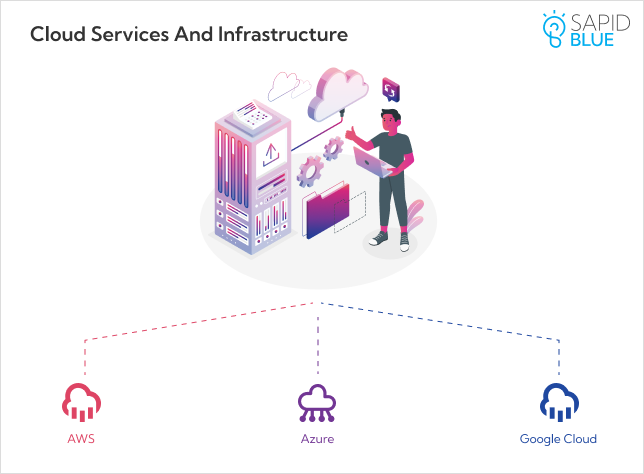
Cloud infrastructure is the foundation of modern SaaS applications. It enables businesses to scale on demand, improve application reliability, support global users, and reduce the cost of managing physical servers. The leading cloud providers offer a range of services for hosting, storage, security, and scalability. Choosing the right platform depends on your business needs, budget, and technical requirements.
a) Amazon Web Services (AWS):
Renowned for its comprehensive suite of services, AWS stands as a frontrunner in the world of cloud computing. Offering a vast array of tools and resources, AWS empowers SaaS developers with scalability, reliability, and a pay-as-you-go pricing model tailored to their needs.
b) Microsoft Azure:
With a powerful infrastructure and seamless integration with Microsoft’s ecosystem, Azure emerges as a compelling choice for SaaS application development. Its extensive range of services, coupled with enterprise-grade security features, makes it an ideal platform for hosting and managing SaaS solutions.
c) Google Cloud Platform (GCP):
GCP brings its own set of advantages to the table, including cutting-edge technologies, intuitive interfaces, and competitive pricing. SaaS developers often find GCP appealing for its machine learning capabilities, global network infrastructure, and commitment to sustainability.
6. DevOps Tools and Practices
Embracing DevOps principles is indispensable for achieving agility, efficiency, and reliability. Continuous Integration and Continuous Deployment (CI/CD) pipelines play a pivotal role in streamlining the development lifecycle, enabling rapid iterations and seamless delivery of new features.
Importance of CI/CD in SaaS Development
CI/CD pipelines automate the process of building, testing, and deploying software, ensuring that updates and enhancements are rolled out swiftly and with minimal manual intervention. By adopting CI/CD practices, SaaS teams can accelerate time-to-market, improve collaboration, and mitigate risks associated with frequent releases.
Popular Tools
a) Jenkins: A leading open-source automation server, Jenkins facilitates continuous integration and delivery by orchestrating workflows and automating repetitive tasks.
b) Docker: Leveraging containerization technology, Docker enables SaaS developers to encapsulate applications and dependencies, ensuring consistency across different environments and simplifying deployment.
c) Kubernetes: As a container orchestration platform, Kubernetes empowers SaaS providers to automate deployment, scaling, and management of containerized applications, thereby optimizing resource utilization and enhancing resilience.
d) GitLab CI/CD: Integrated within GitLab’s ecosystem, GitLab CI/CD offers a seamless workflow for building, testing, and deploying code, enabling SaaS teams to achieve faster feedback cycles and greater visibility into their development process.
Common Mistakes to Avoid When Choosing a SaaS Tech Stack
Choosing the wrong tech stack can lead to higher costs, slower development, and scalability challenges. Avoid these common mistakes when planning your SaaS application:
Prioritizing popularity over practicality: Choose technologies that meet your business and product requirements rather than following industry trends.
Overlooking your team’s expertise: Familiar technologies help teams build, maintain, and deliver products more efficiently.
Planning only for current needs: Consider future growth so your application can scale without major redevelopment.
Delaying security planning: Incorporate security, compliance, and data privacy from the start to reduce risks later.
Adding unnecessary complexity: Build a simple, maintainable architecture that can evolve as your product grows.
Overlooking integration requirements: Make sure your tech stack can easily connect with the third-party services, APIs, and business tools your application depends on.
7. Trends in SaaS Development
As SaaS continues to evolve, modern technology stacks are becoming more intelligent, flexible, and scalable. Here are some key trends shaping SaaS development in 2026:
AI-first applications: More SaaS products are being built with AI at their core, enabling intelligent automation, personalized experiences, and smarter decision-making.
Composable architecture: Businesses are adopting modular applications connected through APIs, making it easier to integrate new tools, replace components, and scale efficiently.
Serverless computing and microservices: These architectures improve scalability, simplify deployments, and allow teams to update individual services without affecting the entire application.
AI-ready databases: Modern databases, such as PostgreSQL with vector search capabilities, are making it easier to build AI-powered features like semantic search, recommendations, and intelligent search experiences.
Frequently Asked Questions
1. How crucial is the choice of a tech stack for SaaS application development?
The tech stack forms the backbone of any SaaS application, influencing its performance, scalability, and market competitiveness. It determines the efficiency of development processes, resource utilisation, and the ease of integrating new features and updates.
2. What factors should I consider when understanding my requirements for selecting a tech stack?
Key factors to consider include your business goals and objectives, target audience preferences and needs, as well as budgetary constraints and resource availability. Aligning technology choices with these aspects ensures that your SaaS application resonates deeply with its intended audience while fitting your unique circumstances.
3. Which front-end frameworks are recommended for SaaS development, and how do I choose the right one?
Three prominent front-end frameworks for SaaS development are React.js, Vue.js, and Angular. The choice depends on factors such as project complexity, team expertise, and performance requirements. React.js is flexible and widely adopted, Vue.js offers simplicity and scalability, while Angular is strong for large-scale enterprise applications.
4. What are the popular back-end frameworks and languages for SaaS development?
Popular choices include Node.js for its scalability, Ruby on Rails for rapid prototyping, Django (Python) for strong security and scalability, and Java/Spring Boot for performance, scalability, and security, particularly for enterprise-grade applications.
5. Why should I opt for cloud services and infrastructure for hosting my SaaS application?
Cloud infrastructure offers benefits like scalability, flexibility, cost-effectiveness, and global accessibility. Leading providers such as AWS, Microsoft Azure, and Google Cloud Platform offer a vast array of services tailored to SaaS development needs, ensuring seamless deployment, scaling, and enhanced security.
Product Manager with 8+ years of experience building and scaling digital products across fintech, blockchain, AI, and enterprise software.
Currently working on fintech and Web3 products including crypto wallet infrastructure, while leading cross-functional teams across design, engineering, and QA.


 Contact Us