



 Contact Us

 Key Takeaways

What is Attack Surface Management: Process, Tools & Enterprise Use Cases
Attack surface management (ASM) is the ongoing process of discovering an organization’s assets and exposure points, assessing their risk, and coordinating remediation with verification. It helps security teams understand what attackers could reach, prioritize consequential exposures, and confirm that fixes reduce risk.
Maintaining that visibility becomes harder as businesses launch cloud services, acquire companies, connect SaaS applications, and introduce AI tools. A useful security inventory should help teams answer a practical question: which exposed systems could put our operations or data at risk?
This guide explains the ASM process, enterprise use cases, tool selection, and implementation considerations. It also covers AI-related exposures and how to measure progress through verified exposure reduction.
What is Attack Surface and Attack Surface Management?
An attack surface comprises the points where an attacker could gain access, influence a system, or obtain data. It includes application interfaces, network services, identities, devices, and interactions involving people.
An attack surface is broader than a list of vulnerabilities. A public customer portal remains part of the attack surface even when correctly configured. A weakness such as broken access control can make that interaction exploitable.
ASM connects asset visibility with ownership, risk assessment, remediation, and verification. Knowing the attack surface helps organizations include overlooked assets in patching, monitoring, and incident response.
Consider a hypothetical acquisition: an old support portal remains online outside the documented inventory, still accepting employee credentials and connecting to customer data. ASM helps uncover the portal and assign responsibility for securing or retiring it.
What Are the Different Types of Attack Surfaces?
An organization’s attack surface includes its digital systems, people, physical assets, and third-party connections. These categories overlap, so an assessment should examine both individual exposure points and how they connect to business operations.
External Digital Attack Surface
The external digital attack surface includes assets reachable through the internet, such as websites, public APIs, remote access services, and cloud storage. Forgotten applications, exposed administration interfaces, and misconfigured services can create unintended entry points. Businesses should understand which assets are publicly accessible, why they remain available, and who maintains them.
Internal Digital Attack Surface
The internal digital attack surface includes workstations, databases, internal applications, network services, and service accounts. These resources may become accessible after an attacker compromises a device or identity. Excessive permissions and weak network separation can allow that initial access to spread, making internal access boundaries important even for systems without public interfaces.
Human and Identity Attack Surface
Employees, contractors, administrators, and account-recovery processes form part of the human and identity attack surface. Attackers may use phishing, impersonation, or misleading access requests to obtain credentials or permissions. Assessment should cover how users authenticate, how privileges are granted, and how sensitive requests are verified, particularly for administrators and support teams.
Physical Attack Surface
The physical attack surface includes devices, equipment, and locations that someone could access directly. Lost laptops, unattended workstations, exposed network ports, and unsecured server areas can create opportunities for unauthorized access or data theft. Relevant controls include device protection, restricted access to sensitive locations, and clear procedures for handling lost equipment.
Third-Party Attack Surface
Supplier-hosted applications, vendor integrations, federated identities, and outsourced administration extend exposure beyond systems the organization directly operates. A compromised supplier account or overly privileged connector can affect connected business services. Businesses should review the access each relationship requires, the information exchanged, and the responsibilities for security, incident response, and access removal.
Digital ASM tools contribute visibility into these exposures alongside identity governance, physical security, supplier oversight, and employee awareness programs.
Where Do EASM, CAASM, DRPS, and Vulnerability Management Fit?
ASM combines capabilities with different scopes. Their boundaries vary across products, so evaluation should focus on the visibility each capability provides.
| Capability | Primary focus | Contribution to ASM |
|---|---|---|
| External Attack Surface Management (EASM) | Internet-facing assets and exposures | Finds exposed infrastructure, including assets absent from internal records |
| Cyber Asset Attack Surface Management (CAASM) | Asset data reconciled across connected enterprise systems | Identifies inventory discrepancies, ownership gaps, and missing security coverage |
| Digital Risk Protection Services (DRPS) | External threats involving the brand, credentials, or information | Surfaces impersonation, leaked credentials, and threats beyond owned infrastructure |
EASM focuses on externally visible assets and exposures; ASM can combine external, internal, cloud, and identity perspectives. CAASM visibility depends on connected sources, permissions, and data quality.
How Does ASM Differ from Vulnerability Management?
| Aspect | Attack Surface Management (ASM) | Vulnerability Management (VM) |
|---|---|---|
| Primary focus | Discover assets and understand how their exposure creates risk | Identify, prioritize, remediate, and verify vulnerabilities |
| Scope | Forgotten services, exposed assets, misconfigurations, and excessive access | Vulnerabilities in systems and software |
| Contribution | Establishes what needs assessment and adds exposure context | Provides vulnerability findings and remediation workflows |
How Does ASM Fit Into CTEM?
Continuous Threat Exposure Management (CTEM) organizes exposure management around business priorities. Its five stages are scoping, discovery, prioritization, validation, and mobilization.
ASM contributes asset visibility and exposure context to that cycle. Establishing CTEM also requires validation capability, accountable owners, and cross-team remediation capacity.
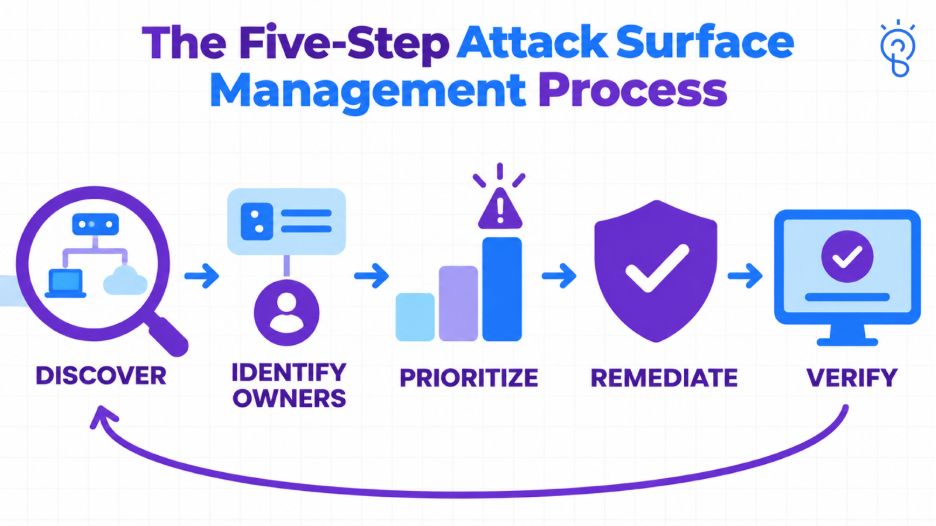
How Does Attack Surface Management Work? Five Practical Steps
ASM repeats a cycle of discovery, context building, assessment, remediation, and verification. The following five steps provide a practical operating model; terminology varies across organizations and products.
1. Discover Assets Across the Agreed Scope
Combine external observations with internal records:
- Domains, DNS records, certificates, and internet-facing services.
- Cloud accounts, workloads, and storage inventories.
- Endpoint management and detection systems.
- Identity providers, service accounts, and SaaS platforms.
- Configuration databases, procurement records, and application catalogs.
External discovery can reveal assets missing from internal inventories; internal records help explain their purpose. Active testing should follow agreed scope and operational limits, particularly for production, industrial, and third-party systems.
2. Reconcile Records and Establish Ownership
Reconcile cloud instance IDs, changing IP addresses, hostnames, and endpoint identifiers into trustworthy asset records. Retain source evidence, observation timestamps, and confidence in inferred relationships. Shared hosting and reused IP addresses can cause incorrect attribution.
Connect each relevant asset to an accountable owner, business service, and lifecycle state. Route unowned assets into an ownership-resolution workflow.
3. Assess, Prioritize, and Validate Risks
Assess software vulnerabilities alongside misconfigurations, excessive permissions, exposed secrets, and missing security controls. Prioritization should consider:
- Known exploitation: Prioritize relevant vulnerabilities that attackers are actively exploiting.
- Exploitation likelihood: Assess how likely a vulnerability is to be exploited, alongside evidence of current threats.
- Reachability and impact: Evaluate how attackers could access an asset and the potential consequences for operations and sensitive data.
- Effective mitigations: Verify that existing security controls reduce exposure and restrict unauthorized access.
For example, an exposed remote access service with a known exploited vulnerability may warrant action before a higher-scoring issue on an effectively isolated development system.
Validate ownership, affected configuration, reachability, and vendor guidance. A version banner alone may misidentify a vulnerability when security fixes have been backported. Intrusive tests require authorization and safeguards; urgent remediation should not wait for an unnecessary exploit demonstration.
4. Remediate Through an Accountable Workflow
Assign findings with supporting evidence, a recommended action, priority, and due date. To reduce the attack surface, patch affected software, restrict administrative access, apply least privilege, revoke exposed credentials, segment critical systems, and retire unused services.
Fix recurring problems at their source, such as an infrastructure template that repeatedly exposes a service. Deleting a visible secret does not replace revocation or rotation.
Record approved exceptions with compensating controls and expiry dates. Automate bounded, reversible changes with tested rollback; changes that could interrupt business services need appropriate review.
5. Verify the Fix and Monitor for Change
Retest the relevant condition before closing a finding. After restricting a management interface, for example, confirm that unauthorized access is blocked from the relevant network position. A failed scan caused by a collector outage is inconclusive.
Three practical components of attack surface monitoring are change detection, risk reassessment, and verified response. Feed new assets and changed configurations back into the same process. Three practical components of attack surface monitoring are change detection, risk reassessment, and verified response. Feed new assets and changed configurations back into the same process.
What Are the Main Enterprise Use Cases for ASM?
ASM helps enterprises investigate exposure created by growth, infrastructure change, and gaps between security systems.
| Enterprise use case | Question ASM helps answer |
|---|---|
| Shadow IT and forgotten services | Which services are missing from approved inventories? |
| Cloud expansion | Which resources have become publicly reachable or drifted from expected configurations? |
| Mergers and acquisitions | Which inherited assets sit outside established security coverage? |
| Security coverage assurance | Which assets lack required endpoint or management controls? |
| Remote access review | Where are administration and remote access interfaces externally reachable? |
| Supplier-hosted applications | Which exposed services depend on third-party hosting or administration? |
For an initial ASM assessment, trace one critical business service from asset discovery to verified closure. This provides a baseline for identifying gaps in data, accountability, and response.
How Does AI Adoption Expand an Enterprise Attack Surface?
AI introduces model endpoints, SaaS accounts, vector databases, retrieval pipelines, agent tools, and service identities that need security ownership and inventory coverage.
An agent that updates a CRM creates exposure through its permissions and connected systems. Capture its data sources, available actions, and access boundaries alongside the interface itself.
ASM supports visibility; separate application testing must evaluate authorization, retrieval boundaries, untrusted content, and permitted actions.
AI can also suggest asset matches or summarize findings within ASM workflows. Retain supporting evidence and review consequential inferences before they affect ownership or production changes.
Which Attack Surface Management Tools Should Enterprises Evaluate in 2026?
Select tools against documented visibility and response gaps. External discovery, inventory reconciliation, and brand protection address different needs.
These examples reflect official documentation reviewed on 26 October 2026. They are capability examples, not a hands-on benchmark or ranking.
| Tool or platform | Documented focus | What to establish during evaluation |
|---|---|---|
| Microsoft Defender EASM | External asset discovery and mapping using connections to known discovery seeds | Attribution quality, relevant asset coverage, and workflow integration |
| Palo Alto Networks Cortex Xpanse | External discovery, exposure prioritization, and automated response | Finding accuracy and safeguards around automated actions |
| Axonius Cyber Assets | Aggregating and reconciling enterprise asset data | Connector permissions, data freshness, reconciliation, and ownership gaps |
| Recorded Future Brand Intelligence | Impersonation, phishing-related domains, and leaked credentials | Relevance to digital risks and response responsibilities |
| OWASP Amass | Open-source external asset discovery and attack surface mapping | Engineering effort for operation, data handling, and workflow integration |
The best ASM tool for an enterprise is the one that meets its requirements with demonstrable evidence. Test attributable discoveries sampled finding accuracy, failed-connector alerts, and verified workflow completion. Compare licensing, retention, integrations, implementation, and administration costs. Open-source discovery also requires engineering and operational support.
How Should an Enterprise Implement Attack Surface Management?
Rollout should establish who operates the program, how work is funded, and when coverage can expand. The five-step process above describes the technical workflow; implementation turns it into an operational responsibility.
- Assign decision rights. A program lead coordinates delivery. Security defines assessment standards, service teams schedule changes, and designated risk owners approve exceptions. An executive sponsor resolves capacity and priority conflicts.
- Set the initial boundary and baseline. Start with a critical service or business unit. Agree on included environments, success measures, and the staff capacity available before expanding.
- Prepare platform operations. Assign responsibility for connector credentials, permissions, availability, and collection-failure alerts. Establish access controls and retention rules for sensitive infrastructure data.
- Use rollout acceptance criteria. Confirm that data feeds remain reliable, handoffs reach the right teams, escalation routes work, and reporting supports the agreed measures. Expand when the operating teams can sustain the additional workload.

How Do You Measure ASM Effectiveness and ROI?
Measure visibility quality and verified exposure reduction against a consistent baseline. Asset totals and ticket closures alone provide limited evidence.
| Metric | How to evaluate it |
|---|---|
| Source coverage and freshness | Track connected environments, collection success, permissions, and observation age |
| Ownership coverage | Measure the share of observed in-scope assets with a confirmed owner |
| Discovery usefulness | Count newly confirmed assets missing from the previous inventory; separate uncertain matches |
| Finding precision | Sample findings and measure the proportion confirmed actionable |
| Verified remediation time | Track median and upper-percentile time to verified closure by priority |
| Exposure recurrence | Measure resolved conditions that return within consistent observation windows |
| Exception health | Track overdue reviews, expired exceptions, and supporting control evidence |
Define the denominator for coverage, such as known cloud accounts or an independently reconciled inventory. Counting discovered assets cannot prove that every unknown asset has been found.
Use the same scope, priority definitions, and reporting windows when comparing results. More findings after improved discovery may reflect better visibility.
Calculating the Financial Case
An ASM ROI model should include subscriptions or engineering, integrations, infrastructure, administration, triage, and incremental remediation effort. Separate cash savings from staff capacity gained, and avoid double-counting benefits.
ROI = (realized benefits − program cost) ÷ program cost × 100
In a hypothetical annual evaluation, reducing reconciliation from 120 to 80 hours monthly releases 480 hours. At an assumed $50 hourly labor cost, that capacity is worth $24,000. Add $12,000 in verified service-retirement savings against a $30,000 program cost, and value-based ROI is 20%.
If only the $12,000 reduction becomes a cash benefit, cash-only ROI is −60%. Report verified risk reduction separately; an unsupported “avoided breach” estimate can distort the investment case.
How SapidBlue Can Help with Attack Surface Management?
SapidBlue offers cybersecurity product and platform engineering for enterprises and cybersecurity product companies building or extending security software. Its capabilities include ASM tooling, asset discovery, inventory and configuration management, and data unification.
Support focuses on developing and integrating the technology security teams use to operate their ASM programs:
- Asset and configuration engineering: Build visibility into assets and configuration changes.
- Data unification: Reconcile observations across sources and timestamps.
- Vulnerability-data integration: Connect CVE information with asset and configuration records.
- Enterprise connectors: Extend integrations between security products and enterprise systems, consistent with SapidBlue’s product development services.
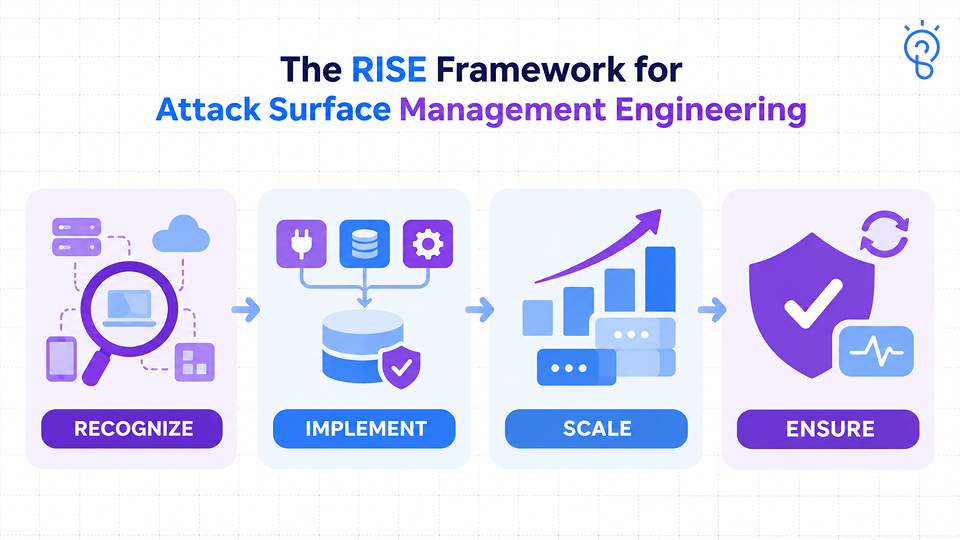
For AI-enabled security product initiatives, SapidBlue’s RISE framework can guide an ASM engineering brief:
- Recognize: Define the visibility problem and required business outcome.
- Implement: Build and evaluate integrations, asset models, and workflows.
- Scale: Expand coverage while managing cost, accuracy, and performance.
- Ensure: Maintain security, governance, and evaluation as systems change.
Conclusion
An ASM investment should give security and service teams a shared basis for deciding which exposures deserve action. Choose the next engineering investment around the operational gap that matters most to the business.
Discuss an ASM engineering roadmap with SapidBlue to define the integrations, data foundations, and workflows your security program needs.


