



 Contact Us

Choose a public blockchain when your business needs open participation and independently verifiable transactions. Choose a private blockchain when participation must be restricted to approved organizations with agreed governance. Consortium and hybrid designs can combine shared control with selective public verification.
The right choice depends on who needs access, what information must remain confidential, and which parties must agree on changes. If a trusted operator can meet these requirements with a database, blockchain may add unnecessary complexity.
This guide explains the differences, enterprise use cases, privacy controls, security risks, costs, and performance considerations to evaluate before implementation.
What is a Public Blockchain?
A public blockchain is a shared ledger that people can generally inspect and independently verify without joining a privately administered membership group. Major public permissionless networks also allow participation under protocol rules rather than approval by a single network owner.
The business attraction is access to shared infrastructure and an ecosystem beyond one organization’s control. Applications can interact with compatible wallets, assets, and services.
However, the enterprise still operates an application: interfaces, signing systems, monitoring, integrations, and user support. A public network does not remove those responsibilities.
An application on a public blockchain can restrict particular actions to approved accounts. Network openness and application eligibility are separate design choices.
What is a Private Blockchain?
A private blockchain restricts network participation through an operator or an agreed membership process. Organizations define permissions for submitting transactions, operating nodes, validating activity, and accessing information.
Private networks can support shared workflows among known organizations. Their value depends on the governance and verification arrangements those organizations need.
Private does not automatically mean confidential. A network may exclude outsiders while exposing transaction details to every authorized member.
Public/Private and Permissionless/Permissioned Are Different Distinctions
Public/private generally describes how openly a network and its ledger are accessible. Permissionless/permissioned describes whether a particular role, especially validation, requires authorization. These distinctions often align but are not interchangeable: a publicly readable ledger can restrict validation to approved organizations, and a public permissionless network can host an application limited to approved users. Assess reading, transaction submission, validation, and administration separately; none of these labels alone guarantees confidentiality.
What Are Consortium and Hybrid Blockchains?
Consortium and hybrid designs broaden the choice beyond a network controlled by one organization or an openly accessible public network.
| Design | How it works | Business question |
|---|---|---|
| Consortium blockchain | Multiple organizations share governance of a permissioned network | Can the members agree on admission, validation, upgrades, disputes, and costs? |
| Hybrid blockchain architecture | Private components connect with public infrastructure for selected functions | What must remain confidential, and what must outsiders be able to verify? |
A consortium needs meaningful shared authority. Several companies using nodes administered entirely by one supplier do not necessarily have independent operational control.
“Hybrid” is used inconsistently. Specify the actual architecture: for example, private records with periodic public commitments, or an access-controlled asset application on a public chain.
A public commitment can help verify that a supplied record matches an earlier commitment. It does not make the underlying record available or prove that its original contents were true.
What Are the Main Differences Between Public and Private Blockchains?
The main difference is how participation and control are organized. Privacy, performance, and cost follow from the specific implementation rather than the label alone.
| Factor | Public blockchain | Private blockchain |
|---|---|---|
| Participation | Generally open under network rules; applications may impose restrictions | Network roles are assigned to approved participants |
| Governance | Protocol changes follow the network’s governance arrangements | Changes follow operator or consortium agreements |
| Data visibility | Standard public-chain transactions can expose activity and state | Visibility depends on permissions and confidentiality mechanisms |
| Validation | Uses the selected public network’s validator and consensus model | Uses an authorized validation arrangement chosen for the network |
| Operating costs | Transaction fees plus application, access, security, and integration costs | Node infrastructure, operations, security, membership, and governance costs |
| Performance | Depends on the chain, execution layer, congestion, and finality requirements | Depends on consensus, topology, endorsement rules, and workload |
| External connectivity | Can provide access to existing compatible assets and applications | External connections must be designed and maintained |
| Enterprise control | Limited control over the underlying public protocol | Greater control over network configuration, with corresponding responsibilities |
Compare candidate architectures against mandatory requirements before assigning scores. A design that exposes prohibited information remains unsuitable even if its fees or throughput look attractive.
When Should a Business Use Blockchain Instead of a Database?
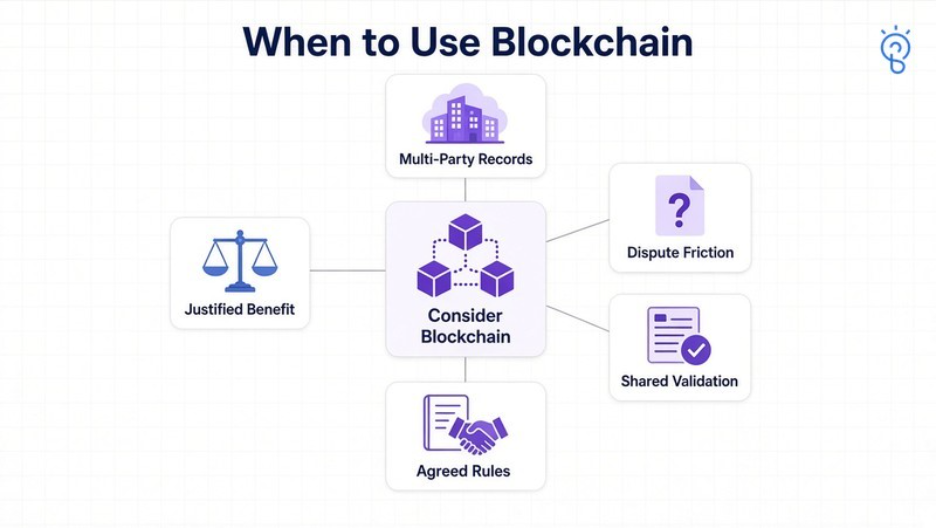
Blockchain deserves consideration when independent parties need a shared transaction history and cannot adequately rely on one accepted operator to maintain it.
Start by testing these conditions:
- Multiple organizations need to submit or verify records.
- Disputes about sequence, authorization, or changes create measurable friction.
- Shared validation provides value beyond ordinary access-controlled storage.
- Participants will agree on operating rules and continue using the system.
- The expected benefit justifies additional integration and governance work.
A database is often the better choice when one organization controls the workflow and all participants accept its authority. APIs, access controls, signed records, and audit logs may satisfy the requirement.
An internal approval application does not need blockchain simply because its records are important. Likewise, a shared database may serve business partners if they accept an independent service operator.
Blockchain also cannot verify a physical event merely by recording a submitted claim. Supplier identity, sensors, document checks, and dispute processes still determine the quality of incoming information.
Compare the proposal with a credible database baseline. Measure reconciliation effort, disputed records, process completion time, and support costs before choosing the infrastructure.
What Are the Enterprise Use Cases for Public and Private Blockchains?
Suitable use cases depend on the parties involved, the information being shared, and the need for external verification. These examples describe possible designs rather than guaranteed benefits.
Public Blockchain Use Cases
Public networks can be useful for:
- Digital assets with external participants: Represent and transfer assets where access to compatible wallets or services matters.
- Publicly verifiable records: Publish carefully designed proofs that customers or other outsiders can check.
- Payments using existing on-chain assets: Connect applications to supported payment networks while managing custody, reconciliation, and operational controls.
- Cross-application ownership: Support assets or entitlements intended to work across independently operated applications.
Public availability does not guarantee liquidity, interoperability with every service, or recognition of an asset’s legal rights. Each dependency needs validation.
Private and Consortium Blockchain Use Cases
Permissioned networks can be useful for:
- Supply-chain coordination: Record agreed handoffs or provenance events across manufacturers, logistics providers, and distributors.
- Shared financial workflows: Coordinate records or approvals among identified institutions with defined access requirements.
- Intercompany reconciliation: Maintain an agreed history of obligations and adjustments across participating organizations.
- Commercial document workflows: Track approvals and evidence while restricting detailed records to authorized parties.
The benefit comes from participating organizations adopting the same process. A technically successful network with incomplete partner participation can preserve the original reconciliation problem.
How Do Private Blockchains Protect Commercially Sensitive Data?
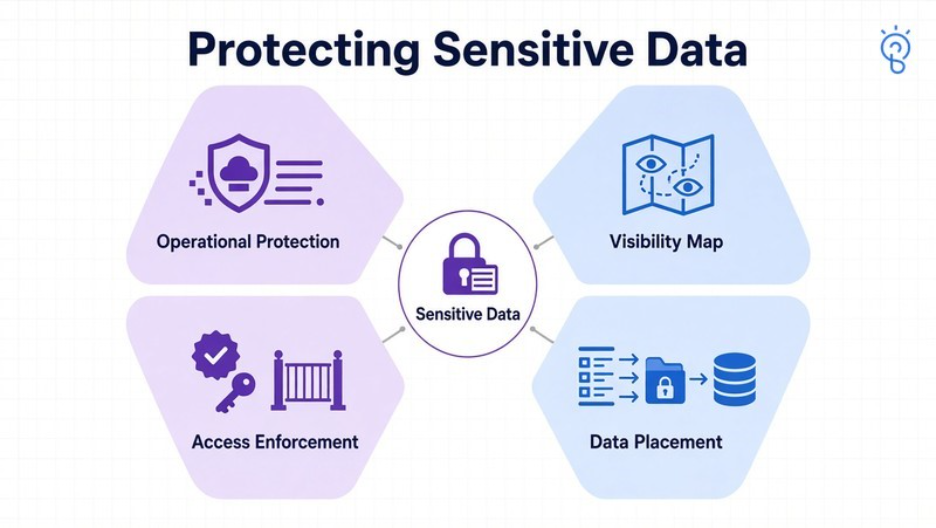
Private blockchains protect information through specific controls over distribution, access, storage, and key management. Restricting membership is only one part of that design. Channels can separate entire transaction histories among defined groups.
For an enterprise application, establish:
- A visibility map: Which organizations may see each field, document, and transaction relationship?
- Data placement: Which information belongs on the ledger, in restricted collections, or in an external store?
- Access enforcement: How are identities verified, permissions changed, and departing participants removed?
- Operational protection: How do backups, logs, analytics, administrators, and support tools handle the same information?
A sensible design may keep contracts and commercial documents in controlled storage while recording selected approvals or verification references on the ledger.
Hashing is not encryption. Predictable inputs can sometimes be guessed and checked against a published hash, so assess the disclosure risk of the commitment design.
Also consider metadata. Timing, transaction patterns, identifiers, and relationships can reveal business activity even when document contents remain restricted.
Which is More Secure: Public or Private Blockchain?
Neither model is inherently more secure for every business. Compare confidentiality, transaction integrity, availability, administrative authority, and recovery under the intended threat model.
| Risk area | Public-network considerations | Private-network considerations |
|---|---|---|
| Validator control | Examine consensus security and actual concentration of influence | Examine collusion, compromised members, and independence of authorized operators |
| Application defects | Public deployment can make vulnerable code accessible to attackers | Restricted membership does not prevent flawed authorization or business logic |
| Sensitive information | Public state and activity may expose commercially useful information | Overbroad member access, backups, and administrator permissions can expose records |
| Operational failure | Assess network access providers and any additional execution layers | Assess node availability, certificates, upgrades, and quorum requirements |
| Privileged changes | Identify contract upgrade keys and application administrators | Identify membership administrators, policy owners, and network-change authority |
A strong underlying network cannot compensate for a stolen application signing key or an unsafe contract upgrade.
For private networks, running several nodes in one cloud account under the same administrator may provide less independence than the node count suggests. Check organizational control as well as technical distribution.
Document what happens if a member acts maliciously, an operator becomes unavailable, or an administrator’s credentials are compromised. Fault tolerance depends on the chosen protocol and configuration; there is no universal attack threshold for every blockchain.
Use secure development, independent review, testing, and monitoring. Ethereum’s smart-contract security guidance recommends independent review and explains that an audit cannot identify every defect.
How Do Public and Private Blockchains Compare in Cost?
Public blockchains are not automatically cheaper, and private blockchains are not free because they avoid public-network gas fees. Compare total lifecycle costs for architectures that meet the same requirements.
Public Blockchain Costs
An enterprise should budget for transaction fees, network-access services, indexing, signing or custody systems, monitoring, security reviews, integrations, and support.
The fee depends on the selected network, transaction complexity, and demand. Fee sponsorship can simplify the user experience while leaving someone responsible for payment.
Private Blockchain Costs
A private deployment can avoid externally priced gas while requiring funding for nodes, storage, backups, certificates, monitoring, security, upgrades, member onboarding, and governance.
Managed infrastructure changes who performs operational tasks; it does not remove the costs or the need to define responsibilities.
Include development, migration, integration, and future exit costs in the full business case for either model.
An Illustrative Annual Cost Scenario
Assume one million executed transactions annually. The figures below are invented planning assumptions, not current gas prices, market benchmarks, or SapidBlue quotes.
| Annual running cost | Public option: lower-fee scenario | Public option: higher-fee scenario | Private option |
|---|---|---|---|
| Transaction fees | $20,000 at $0.02 average | $200,000 at $0.20 average | $0 externally charged fee, by assumption |
| Infrastructure and access services | $25,000 | $25,000 | $60,000 |
| Operations, security, and governance | $45,000 | $45,000 | $100,000 |
| Total modeled annual running cost | $90,000 | $270,000 | $160,000 |
This example excludes initial development and migration. It assumes comparable application scope, not equivalent trust or privacy properties.
With the other assumptions fixed, public transaction fees reach $90,000 before its running cost equals $160,000. At one million transactions, that is an average fee of $0.09.
The practical lesson is to test fee and workload sensitivity. Also model failed transactions, retries, batching, and token-price exposure where relevant. Compare cost per completed business workflow rather than treating each blockchain write as a successful outcome.
How Do Transaction Speed and Throughput Compare?
Private networks can achieve low latency through controlled membership and tailored validation. Public-network performance varies substantially by chain and execution layer. Neither category has one meaningful transactions-per-second figure.
A benchmark should distinguish:
- Submission: The application accepts or broadcasts a request.
- Inclusion: The transaction appears in a block or ordered ledger.
- Finality: The network’s rules provide the assurance required to treat the result as settled.
- Business completion: Connected systems and required approvals have completed their work.
An early acknowledgment should not be reported as final settlement.
For Ethereum, layer 2 scaling can execute transactions outside layer 1 and settle through Ethereum. Evaluate the particular implementation’s settlement, data availability, operator dependencies, and recovery arrangements. A sidechain has its own consensus and should not be assumed to provide the same assurances as a rollup.
Build a workload model before comparing advertised TPS. For example, 200,000 business events daily average about 2.3 events per second. At a peak twenty times the average, with three ledger writes per event, the illustrative requirement becomes roughly 139 writes per second.
That is a requirement estimate, not a platform benchmark. Test sustained throughput, high-percentile latency, failures, recovery, and external-system updates using representative contracts, permissions, and data sizes.
Why Are Enterprises Exploring Permissioned Applications on Public Networks?
Permissioned applications on public networks can combine open infrastructure with restrictions on who may transact. The potential attraction is access to existing assets and compatible services while retaining application-level eligibility controls.
A documented example is BlackRock’s BUIDL fund. Its March 2024 launch announcement described issuance on Ethereum and transfers between pre-approved investors.
These examples support the viability of controlled participation on public infrastructure. They do not establish an industry-wide migration away from private blockchains.
Evaluate three distinct layers:
- Network access: Who operates the underlying infrastructure?
- Application permissions: Who may hold an asset or execute an operation?
- Information privacy: What can observers, operators, and counterparties learn?
Restricting transfers does not automatically conceal balances or transaction relationships. Likewise, using a zero-knowledge proof system does not automatically make the entire application confidential.
The choice is a concrete architecture with defined permissions and disclosures, rather than a requirement to adopt a particular industry narrative.
How Should You Choose and Implement the Right Blockchain?
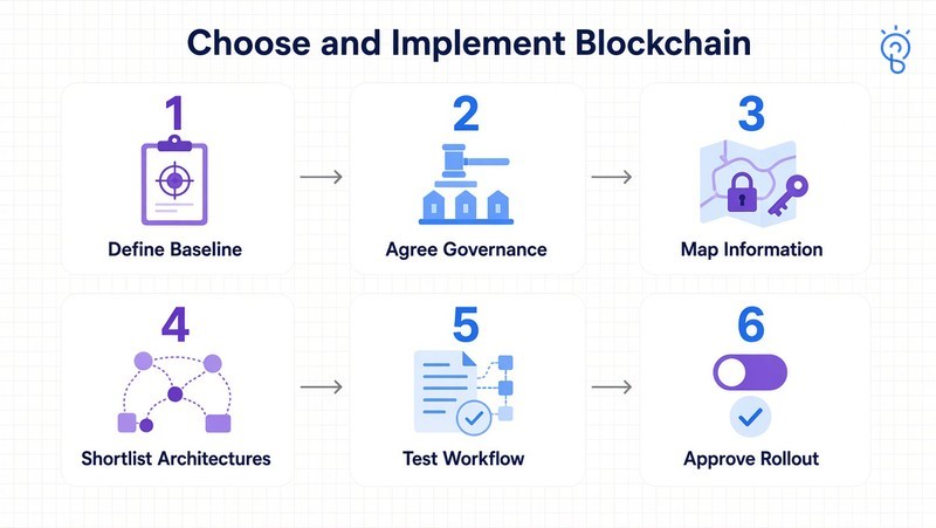
Choose the least complex architecture that satisfies the workflow, trust, and information requirements. Validate uncertain assumptions before committing to production.
- Define the outcome and baseline. Identify participants, shared records, disputed events, existing reconciliation costs, and the database alternative.
- Agree on governance. Establish who admits members, changes rules, operates infrastructure, resolves disputes, and pays ongoing costs. Document withdrawal and shutdown arrangements.
- Map information and authority. Decide what is public, restricted, or off-chain. Identify signing authority, administrator privileges, and required approvals.
- Shortlist feasible architectures. Assess public, permissioned, consortium, and hybrid designs against mandatory requirements. Specify the actual chain, framework, execution layer, and dependencies.
- Test a complete workflow. Include identity checks, contracts, enterprise-system updates, exceptions, and reconciliation. Exercise permission changes, node outages, failed writes, and key recovery.
- Approve a controlled rollout. Require demonstrated confidentiality, performance, recovery, and cost acceptance. Assign production owners and measure actual business outcomes.
The production application also needs APIs, transaction orchestration, signing controls, off-chain storage where required, an index or query service, monitoring, and a record of confirmed results.
Plan for partial completion across the ledger and enterprise systems. A transaction may succeed while an ERP update fails; recovery must reconcile the state without repeating the business action.
Measure partner adoption and exception workload alongside technical metrics. A ledger that performs well while participants continue maintaining separate records may deliver limited operational value.
How SapidBlue Helps Businesses Implement Blockchain Solutions?
Blockchain implementation requires business-process decisions alongside network, contract, and application engineering. SapidBlue’s services cover evaluating the use case, designing the architecture, and developing public or permissioned solutions.
Relevant capabilities include:
- Feasibility and strategy: Use blockchain strategic advisory to examine business value, readiness, risks, and implementation priorities.
- Architecture planning: Define contracts, data placement, security, infrastructure, and integrations through blockchain implementation design.
- Public-network applications: Develop applications and ecosystem integrations through public blockchain development.
- Permissioned enterprise solutions: Build networks and workflows with defined participation through enterprise blockchain development.
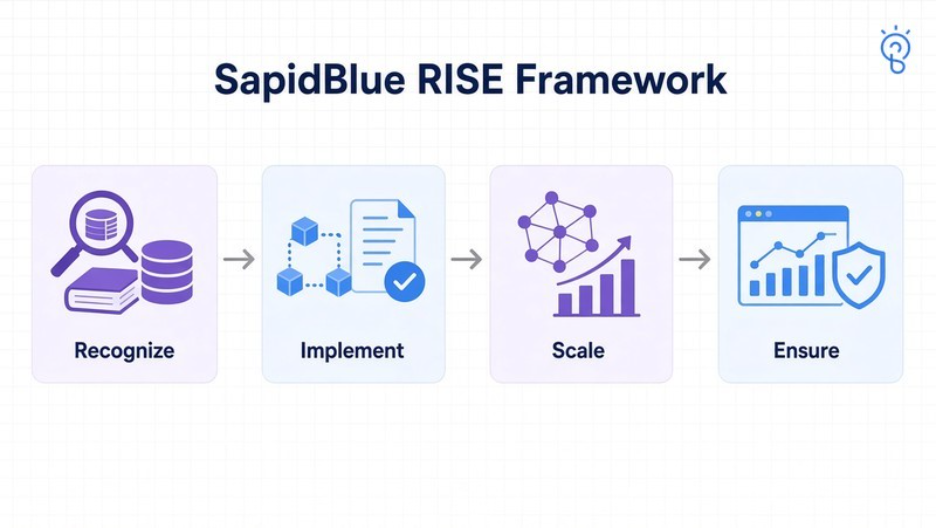
SapidBlue’s RISE Framework names four stages: Recognize, Implement, Scale, and Ensure. Applied to a blockchain project, these can provide distinct checkpoints:
- Recognize: Validate the shared business problem, participant incentives, and reasons to use blockchain rather than a database.
- Implement: Develop the agreed network and application, connect enterprise systems, and test the complete workflow.
- Scale: Evaluate growing transaction volumes, partner participation, operating costs, and support requirements.
- Ensure: Maintain security, governance, monitoring, and change controls as the system and its participants evolve.
The delivery scope should specify the responsibilities of the enterprise, its partners, and any infrastructure providers.
Conclusion
The public vs. private blockchain decision should follow how the business shares authority and information. Start with the value of a shared ledger, then validate governance, confidentiality, cost, and recoverability. Proceed when participants can support both the technical design and the operating model.
Ready to define a blockchain implementation? Work with SapidBlue to scope your architecture, integrations, and production acceptance criteria.


