 Contact Us

 Key Takeaways

SaaS Product Development: How to Build, Launch & Scale
SaaS product development is the process of designing, building, launching, and operating software delivered as an online service. Building a SaaS product that can scale requires validating a recurring customer need, delivering a focused first release, establishing tenant and security boundaries, and expanding capacity based on real usage.
A sustainable SaaS business depends on customers repeatedly receiving value worth paying for. Product, architecture, and operating decisions need to support that outcome together. An early feature can introduce integration work, support costs, or performance demands, so planning should cover how the service will be sold, maintained, updated, and recovered.
This guide explains the SaaS product development process, MVP scope, architecture, technology choices, development costs, and the decisions that support growth in 2026.
What is SaaS Product Development?
SaaS product development is the process of designing, building, launching, and operating software delivered as an online service. Customers commonly pay through subscriptions or usage-based pricing, while the provider manages the application and its ongoing delivery.
The work includes customer research, user experience, application engineering, tenant management, billing, security, deployment, and support. A working application becomes a SaaS product when customers can reliably access and use the service throughout their lifecycle.
Developing a SaaS product can make sense when multiple customers share a recurring problem and a common product can serve them economically. Centralized updates and reusable capabilities can support recurring revenue, but retention depends on continuing customer value.
Before investing, establish why the product should exist. If an existing service already solves the problem adequately, an integration or configuration project may offer a better business case. If every customer requires a different implementation, the proposed offering may need a services business model alongside its software.
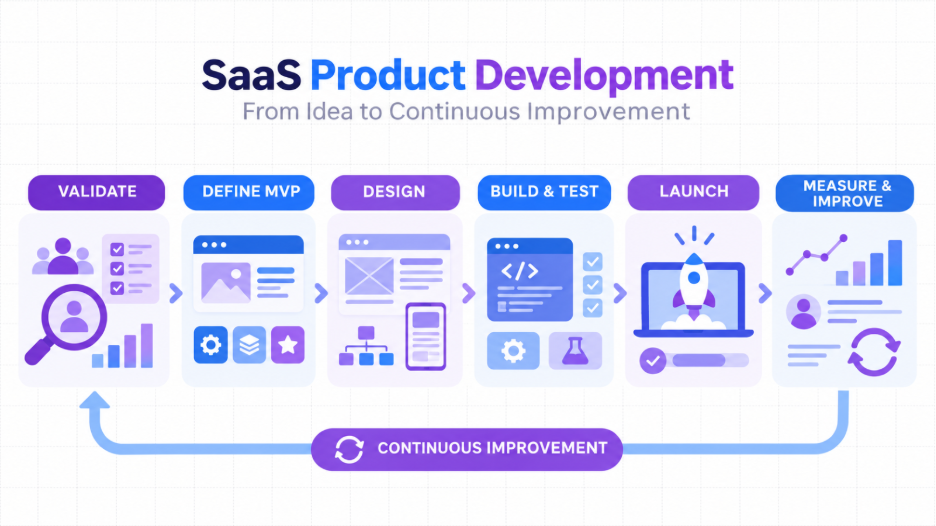
What Are the Steps in the SaaS Product Development Process?
SaaS development is an iterative process with decision points. Each stage should produce evidence or a usable outcome that justifies the next investment.
1. Validate the Problem, Buyer, and Willingness to Pay
Validate a SaaS product idea by investigating how a defined customer segment handles a recurring task today. Interview the people doing the work and the person approving the budget; their priorities may differ.
Useful questions include:
- How often does the problem occur, and what does the current workaround cost?
- Which event makes the customer look for a solution?
- What alternatives have they tried, including doing nothing?
- What data, integrations, and approvals would adoption require?
- What result would justify paying and renewing?
A clickable prototype can be used to test understanding of the workflow and fit. A manually delivered service can be used to test the proposed outcome prior to the full platform being in existence. A paid pilot can provide far stronger commercial evidence than a mere expression of interest, though a pilot in itself doesn’t prove there’s demand out there.
Define your decision criteria prior to testing. Take the example of a hypothetical procurement SaaS team who might require their pilot customers to go through the approval workflow on a number of occasions, identify a budget owner and accept the proposed pricing model before they would be in any position to fund a larger build.
This approach follows the emphasis on experiments and validated learning in Eric Ries’s Lean Startup methodology.
2. Set a Focused SaaS MVP Scope
A SaaS minimum viable product should let the target customer complete one valuable workflow and let the team evaluate the business assumptions behind it. Scope should include the operational capabilities needed to deliver that workflow safely.
| MVP capability | Purpose in the first release |
|---|---|
| Core customer workflow | Deliver the outcome being validated, such as submitting and approving a purchase request |
| Account and workspace setup | Establish the customer organization, users, invitations, and access boundaries |
| Appropriate permissions | Control who can view information and perform actions |
| Commercial access management | Connect plans, contracts, trials, or billing to the service a customer is entitled to use |
| Usage and outcome measurement | Observe activation, workflow completion, and repeat use |
| Operational support | Provide error reporting, administrative support, backups, and recovery appropriate to the release |
Automated self-service billing may be unnecessary for a small, contract-led pilot. The service still needs an accurate way to track who has purchased access and when that access changes.
How Does an MVP Differ from a Minimum Lovable Product (MLP)?
An MVP emphasizes learning through a usable first version. The MLP perspective emphasizes an experience that earns enthusiasm and repeat use. These are established product-planning concepts. A focused MVP can include thoughtful onboarding and clear feedback without becoming a large feature release.
3. Design the Experience and Technical Boundaries
Map the complete customer workflow, including empty states, errors, approvals, and support needs. Test the riskiest interactions with a prototype.
Document tenant boundaries, data ownership, integrations, and operational requirements before implementation. The architecture section below explains the trade-offs; this stage should produce explicit decisions and acceptance criteria.
4. Build and Test Complete Workflow Increments
Deliver small increments that connect the interface, authorization, business logic, persistence, and operational visibility. An increment should produce a usable customer action with meaningful tests around its failure modes.
Integrations need particular care. Subscription access, for example, must remain consistent when payment events arrive late, repeat, or arrive out of sequence.
Automated delivery, versioned database changes, and tested recovery procedures make later releases more predictable.
5. Launch With a Defined Operating Model
Introduce the product to a controlled customer group with clear onboarding, support ownership, and service expectations. Establish who responds to incidents, approves releases, and communicates customer-impacting changes.
Launch readiness should include evidence that the core workflow, tenant access, billing state, and recovery procedures work under representative conditions. The release decision should reflect the product’s actual risk and customer commitments.
6. Measure Adoption and Refine the Product
Track activation around a meaningful result. For a procurement product, that could be completing an approval cycle rather than creating an account.
What Architecture and Tech Stack Support a Scalable SaaS Product?
A scalable SaaS architecture makes customer boundaries explicit and allows capacity to grow without losing control of reliability or operating cost. A tenant is the customer organization or account whose users, data, and configuration need an appropriate boundary.
Choose Tenant Isolation Around Customer Requirements
Single-tenant and multi-tenant are useful shorthand, but isolation decisions can differ across application, database, and infrastructure layers. AWS’s SaaS Lens describes silo, pool, and bridge models.
| Resource model | How it works | Business consideration |
|---|---|---|
| Dedicated or silo | Some or all resources are dedicated to a tenant | Supports stronger resource separation, with greater provisioning and operating overhead |
| Shared or pool | Tenants share selected application or infrastructure resources | Can improve utilization, while requiring effective logical isolation and resource controls |
| Mixed or bridge | Dedicated and shared resources are combined | Supports differentiated needs, such as shared application services with dedicated databases |
Dedicated resources can still form part of a SaaS offering with a common product and operating model. Conversely, a shared database does not establish safe tenant isolation by itself.
Carry validated tenant context through APIs, background jobs, file access, caches, and reporting. A tenant identifier supplied by a client must be checked against the caller’s authorized access. Plan how administrators access customer data and how those actions are audited.
A modular monolith can be a practical starting point when one team owns the product. Separate services become useful when specific workloads need independent deployment, scaling, or ownership. Establish clear module boundaries and measure constraints before adding distributed-system complexity.
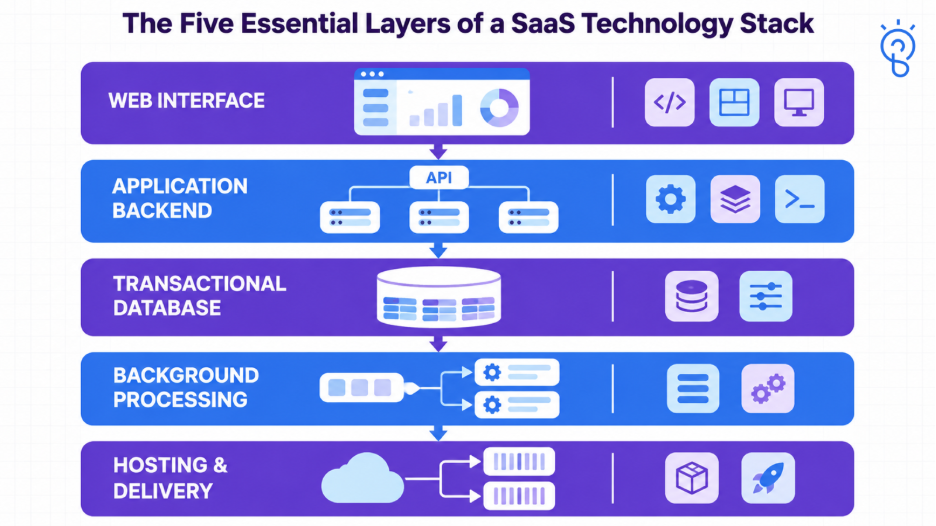
What is the Best Tech Stack for a SaaS Startup in 2026?
The best SaaS tech stack is one the team can deliver and operate effectively within the product’s workload, integration, and customer requirements. There is no universal winner based on the year alone.
| Layer | Practical options | Selection criteria |
|---|---|---|
| Web interface | React, Vue, Angular, or server-rendered interfaces | Interaction needs, accessibility, team experience, and maintenance |
| Application backend | TypeScript/Node.js, Python/Django, ASP.NET Core, or Java/Spring | Domain complexity, ecosystem, integrations, and operational skills |
| Transactional data | PostgreSQL or another suitable managed relational database | Consistency requirements, access patterns, recovery, and database expertise |
| Background processing | Managed queues and worker processes | Retry behavior, throughput, ordering needs, and job visibility |
| Hosting and delivery | Managed application runtimes, containers, and infrastructure as code | Deployment control, staffing, availability needs, and operating cost |
Use supported releases and managed capabilities where they reduce operational burden. Add specialized search, caching, or analytical stores when the workload demonstrates a need.
Before committing to a build, create a one-page SaaS scope brief covering the buyer, core workflow, tenant model, launch requirements, and measurable success criteria. It gives product and engineering teams a shared basis for estimates and trade-offs.
How Should Security and Compliance Be Built into SaaS Development?
Security starts with data and access requirements. Identify what the product stores, who can use it, which actions require additional control, and what customer contracts require.
A SaaS security plan should address:
- Authentication, session handling, least privilege, and administrative access.
- Tenant authorization, including attempts to access another customer’s records or files.
- Encryption, secret management, dependency maintenance, and secure configuration.
- Audit evidence, data retention, deletion, and export requirements.
- Incident response and tested backup restoration.
Translate these requirements into verifiable acceptance criteria and assigned operational responsibilities. Compliance obligations depend on the data, customers, contracts, and jurisdictions involved.
Cloud services help operate parts of the stack, but responsibility remains service-specific. A cloud provider’s assurance reports do not automatically establish the SaaS product’s compliance.
How Much Does SaaS Product Development Cost in 2026?
SaaS product development cost depends on scope, engineering effort, delivery rates, integrations, and the requirements for operating the service. A budget is most useful when it connects those assumptions to a defined release.
The main cost drivers are:
- Workflow complexity: Roles, approvals, business rules, and exception handling.
- Tenant and customer requirements: Isolation, enterprise access, regional deployments, and audit needs.
- Integration and data work: API quality, migrations, synchronization, and third-party limitations.
- Experience and delivery scope: Onboarding, accessibility, supported devices, and release automation.
- AI features: Evaluation, model usage, retrieval pipelines, and human review where required.
A Worked SaaS MVP Budget Example
The following is a hypothetical planning example, using assumed effort and rates in US dollars. It illustrates a focused B2B release with one core workflow, basic roles, managed infrastructure, and limited integrations.
| Workstream | Assumed effort |
|---|---|
| Discovery and scope definition | 80 hours |
| UX design and prototype evaluation | 120 hours |
| Application and integration engineering | 640 hours |
| Quality assurance and security verification | 200 hours |
| Delivery coordination and launch preparation | 80 hours |
| Total | 1,120 hours |
At an assumed blended rate of $60 per hour, labor costs $67,200. Adding an assumed $1,800 for development-period services and tools plus an $8,000 contingency produces an initial planning budget of $77,000.
The $77,000 total applies only to these illustrative assumptions; it is not a typical project price or a SapidBlue offer. Enterprise SSO, substantial data migration, complex integrations, or dedicated tenant environments would require a separate scope and estimate.
The estimate excludes ongoing post-launch operations, formal independent assurance work, and major scope changes. Adjust every assumption to the actual release. Workload hours also do not directly translate into a calendar schedule because dependencies and parallel work affect delivery.
Budget for Operating the Product
Recurring costs include hosting
storage, observability
Messaging
payment services
support, maintenance, and security operations. AI-enabled features can add usage-dependent model costs.
How Do You Build a SaaS Product That Can Scale?
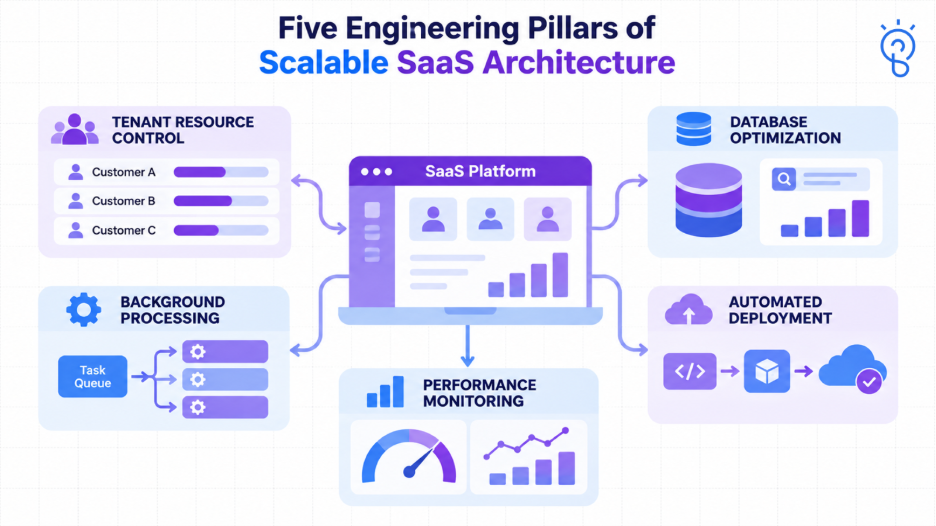
Scaling requires capacity planning, workload controls, and repeatable operations. Model the work customers generate: concurrent requests, large imports, scheduled reports, stored data, and integration traffic.
Focus engineering on demonstrated constraints:
- Protect shared resources. Apply tenant-level limits and workload budgets so one customer’s import or report does not consume everyone’s capacity.
- Separate slow work. Move suitable long-running tasks to observable queues and workers, with retry limits and recovery paths.
- Optimize data access. Measure expensive queries, indexes, connection usage, and storage growth before adding capacity blindly.
- Make changes repeatable. Automate deployment and tenant provisioning; test database migrations and recovery.
- Measure service quality by workload. Track latency percentiles, errors, queue age, and resource saturation alongside cost per tenant.
These can provide additional scale boundaries as the product grows, with trade-offs in isolation, utilization, and management.
How is AI Changing SaaS Product Development in 2026?
AI affects both how teams build software and what a SaaS product can offer. These require separate evaluation.
During development, AI coding tools can assist with implementation, test drafts, and documentation. Assess the impact through completed, accepted work, defects, and maintenance effort rather than code volume.
Within the product, AI may support document extraction, search, summarization, or workflow assistance. Select a feature when its outcome improves the customer’s task enough to justify its cost and failure handling.
AI features need representative evaluation cases, tenant-aware data access, usage limits, and an appropriate fallback. An agent with permission to update customer systems requires stronger action controls than a read-only assistant.
Keep the core service usable when an optional model service is unavailable, and measure the cost of a successfully completed AI-assisted task.
What Are the Main Challenges in SaaS Product Development?
SaaS development challenges often arise where customer expectations meet the economics of maintaining one evolving product.
- Customer-specific requirements can fragment the roadmap. Evaluate requests against the target market and use configuration where requirements genuinely vary. Separate customer code branches create additional testing, upgrade, and support obligations.
- Onboarding can delay the first useful outcome. Customers may need historical data, administrator setup, or internal approval before they can use the service. Define a supported import path and an onboarding milestone that demonstrates value.
- Commercial assumptions can break under real usage. Heavy processing, third-party fees, and manual support can make a seemingly attractive account expensive to serve. Review usage patterns alongside pricing and support effort.
- Ownership can become unclear after launch. Agree who maintains integrations, handles incidents, approves changes, and funds technical maintenance. Include these responsibilities in delivery planning.
How Do You Choose a SaaS Product Development Partner?
Evaluate a SaaS development partner against the decisions the product actually needs. Relevant experience should be supported by architecture explanations, delivery evidence, and agreed responsibilities.
Useful evaluation criteria include:
- Product discovery: Can the team turn customer evidence into a focused release and explicit exclusions?
- SaaS architecture: Can it explain tenant isolation, lifecycle management, billing state, and operational trade-offs?
- Quality and security: Can it demonstrate how tests cover access boundaries, failures, integrations, and recovery?
- Delivery transparency: Will you see working increments, updated estimates, risks, and acceptance evidence?
- Post-launch operation: Who handles incidents, upgrades, monitoring, and support, under what scope?

How SapidBlue Can Help with SaaS Product Development?
SapidBlue provides product and platform engineering for businesses building or extending SaaS products. Its published cloud-native development services include SaaS applications with multi-tenant architecture, APIs, user management, and supporting infrastructure.
Relevant support includes:
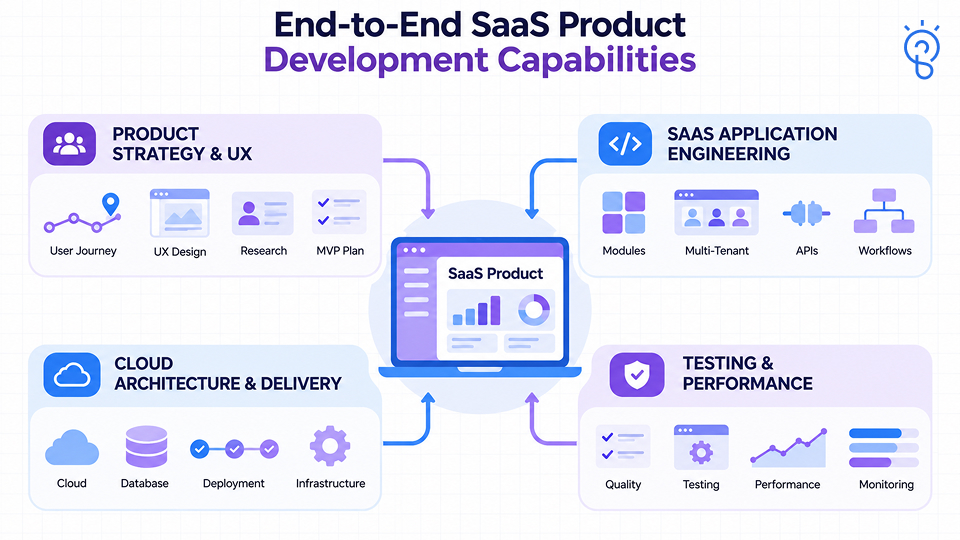
- Product strategy and UX: Shape the customer workflow and first release through SapidBlue’s product development capabilities.
- SaaS application engineering: Build the application, tenant functionality, and integrations around the agreed requirements.
- Cloud architecture and delivery: Establish infrastructure as code, automated delivery, and operational visibility appropriate to the workload.
- Testing and performance optimization: Evaluate functionality and constraints before expanding customer usage.
Which Unit-Economics Metrics Should a SaaS Business Track?
SaaS unit economics connect customer revenue with delivery and acquisition costs. Alongside adoption, track the following SaaS business metrics:
| Metric | What it measures |
|---|---|
| Gross margin | (Revenue − direct delivery costs) ÷ revenue × 100 |
| Customer acquisition cost (CAC) | Attributable sales and marketing costs ÷ new customers acquired |
| Gross-margin-adjusted CAC payback | CAC ÷ monthly gross profit per new customer, expressed in months |
| Net revenue retention (NRR) | Percentage of starting recurring revenue retained from existing customers, including expansion, downgrades, and churn; excludes new customers |
In a hypothetical example, $100 in monthly customer revenue and $40 in direct delivery costs produce $60 in gross profit and a 60% gross margin. A $600 CAC would take 10 months to recover, assuming the customer stays and monthly revenue and costs remain unchanged.
Use consistent cost allocations and matched acquisition cohorts. Review retention alongside payback; recovering CAC does not establish company profitability because other operating expenses remain.
Conclusion
SaaS product development should earn the next investment through evidence: a problem customers will pay to solve, a release they can use successfully, and operating costs the business can support. The next feature or architectural change should address a demonstrated need.
Plan your SaaS product development roadmap with SapidBlue to align MVP scope, tenant architecture, delivery costs, and launch requirements.