
 Contact Us

 Key Takeaways

Recommendation Engine: How It Works, Algorithms & Examples
A recommendation engine is a system that selects and ranks products, content, or services based on their predicted relevance to a user or situation. It uses signals such as behavior, stated preferences, item attributes, and context to help people discover useful options.
For businesses with large catalogs or content libraries, relevant recommendations can make choosing easier. A customer may need a compatible accessory, a learner may need the next course, or a subscriber may want content that reflects their interests. Each situation requires a clear understanding of what makes a suggestion useful.
This guide explains how recommendation engines work, the algorithms they use, and practical business examples. It also covers data requirements, implementation challenges, and how to measure recommendation quality and business value.
What is a Recommendation Engine?
A recommendation engine brings together data, algorithms, business rules, and software components to deliver suggestions within an application. The algorithm predicts relevance, while the wider system handles data updates, available items, access permissions, and user feedback.
A recommendation engine in machine learning learns patterns from data to estimate which items a person may find useful. Simpler recommendation systems can also use rules or popularity lists without a trained model.
A recommendation algorithm is the method used to calculate similarity, predict preference, or order candidates. The engine includes the surrounding data pipelines, APIs, filtering, monitoring, and feedback collection needed to deliver those results.
For example, recommending a compatible charger requires both an estimate of customer interest and a reliable check that the charger fits the device.
How Does a Recommendation Engine Work?
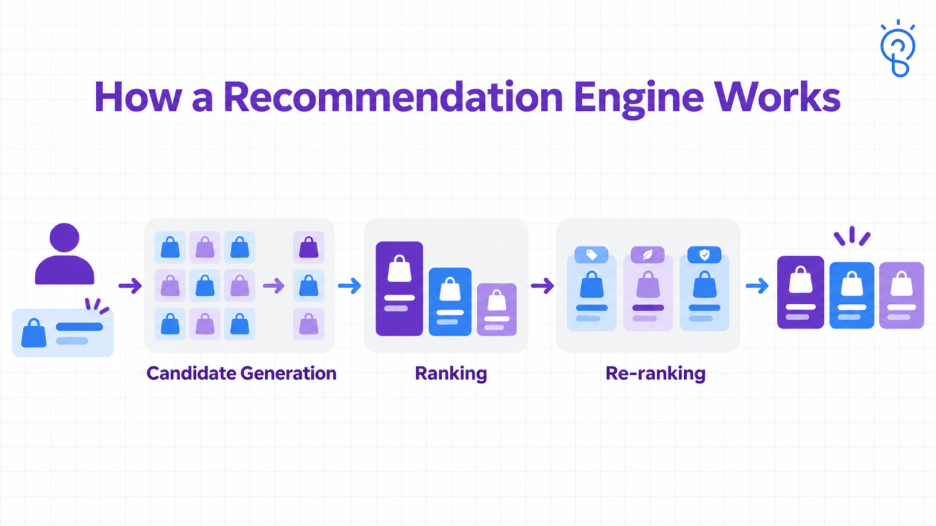
A common recommendation pipeline has three stages: candidate generation, ranking, and re-ranking.
1. Candidate Generation: Find Plausible Options
Candidate generation retrieves a manageable shortlist from the eligible catalog. Sources might include similar items, behavioral relationships, recent interests, and popular products.
Illustrative retail example: A store with 50,000 products retrieves 300 candidates related to a customer’s current browsing session. These numbers illustrate the workflow; they are not recommended thresholds.
Retrieval quality sets an upper limit on the later stages. A relevant product omitted here cannot be recovered by a ranker that only sees the shortlist.
2. Ranking: Estimate Relevance
A ranking model scores candidates using information such as user history, item characteristics, session activity, and the intended outcome.
The objective needs a precise definition. Predicting a click, a completed purchase, and a successfully completed course are different tasks. Optimizing one does not establish improvement in the others.
3. Re-ranking: Shape the Final List
Re-ranking adjusts the order or composition of the list. It can reduce repetition, broaden categories, or balance relevance with freshness.
Mandatory eligibility rules should also be enforced wherever needed, including before retrieval and immediately before display or action. Permissions, compatibility, and availability should not depend on a model’s relevance score.
How Do Recommendation Engines Personalize Results in Real Time?
Real-time personalization uses recent signals, such as a search or product view, to influence the next recommendation request. A system might update session features, retrieve different candidates, or re-score an existing shortlist.
Real-time recommendations do not necessarily require real-time model retraining. A periodically trained model can use fresh session data at serving time.
What Data Does a Recommendation Engine Need?
Recommendation engines combine preference signals with reliable information about the items they can recommend. Explicit and implicit feedback describe how preferences are obtained.
| Data category | Examples | How to interpret it |
|---|---|---|
| Explicit feedback | Ratings, stated interests, “not interested” selections | Directly expressed preferences, although participation may be limited |
| Implicit feedback | Views, clicks, purchases, viewing duration | Behavioral evidence whose meaning depends on context |
| Item information | Category, description, price, language, compatibility | Attributes used for matching and eligibility |
| Context | Current session, device, location where appropriate, time | Information that helps distinguish the current need from historical interests |
A click can indicate curiosity rather than satisfaction. An item with no recorded interaction may never have been shown to the user. Missing feedback should not automatically become evidence of dislike.
Record recommendation impressions as well as outcomes: which items were displayed, in what positions, under which model or experiment version, and what happened afterward. Stable identifiers and timestamps make those events useful for evaluation.
What Types and Algorithms Do Recommendation Engines Use?
Recommendation engines use different approaches to identify relevant items. The choice depends on available interaction data, item information, user requirements, and business goals.
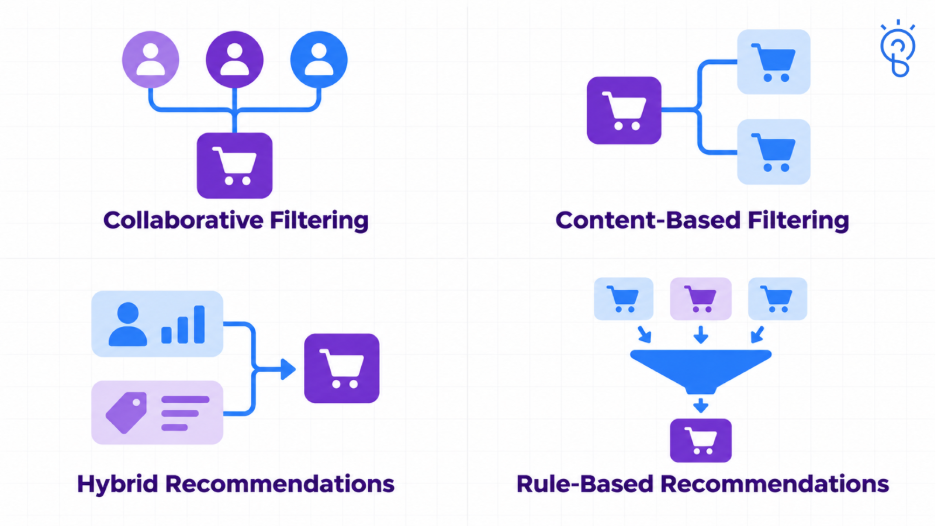
1.Collaborative Filtering
Collaborative filtering learns from interactions across users and items, such as purchases, ratings, or viewing activity. Common methods include user-based and item-based nearest neighbors, along with matrix factorization. It can identify relationships that are not obvious from product attributes, but limited interaction history makes recommendations harder for new users and items.
2.Content-Based Filtering
Content-based filtering recommends items whose attributes match a user’s interests or the item currently being viewed. Methods include attribute matching, TF-IDF, embeddings, and cosine similarity. Its effectiveness depends on informative descriptions and consistent features. Recommendations can become repetitive when the system continually selects items similar to previous choices.
3.Hybrid Recommendation Systems
Hybrid systems combine approaches to use behavioral patterns alongside item attributes and contextual signals. They may blend candidate lists, combine features in a ranking model, or switch methods when data is limited. Evaluate the complete system to confirm that combining methods improves relevance without introducing unnecessary complexity.
4. Knowledge-Based and Rule-Based Recommendations
Knowledge-based recommendations match items to explicit needs, such as a customer’s budget, preferred features, or compatibility requirements. Rule-based methods apply defined conditions, including eligibility filters and expert-created matching rules. These approaches are useful when requirements matter more than historical behavior and can also support other recommendation methods.
How Do Matrix Factorization, SVD, and ALS Work?
Matrix factorization represents users and items as compact numerical vectors, often called latent factors or embeddings. Their dot product estimates affinity. The factors capture patterns learned from interactions; they do not necessarily correspond to named characteristics such as price or genre.
SVD, or singular value decomposition, is a matrix decomposition technique. Recommender libraries also use “SVD” for related factor models trained on observed ratings.
ALS, or alternating least squares, is an optimization method that alternates between updating user factors and item factors.
The practical choice depends on the signal available and the recommendation task, rather than which acronym sounds more advanced.
What Are Real World Recommendation Engine Examples?
Public descriptions from established platforms show how recommendation systems support different discovery experiences. These examples explain documented mechanisms, rather than revealing complete current architectures.
Netflix: Personalized Title Discovery
Netflix recommends films and shows using viewing history, ratings, title information, and preferences shared by similar viewers. In 2015, Netflix researchers reported that its recommendation system influenced choices accounting for about 80% of hours streamed. This historical figure illustrates the importance of recommendations to content discovery; it is not a current viewing statistic. Netflix Help Center
Amazon: Interest-Based Product Recommendations
Amazon’s Interests feature lets customers describe what they want in their own words. It then suggests matching products and notifies them about relevant new arrivals, restocks, and deals. Amazon reports that nearly 20% of customers who created Interests added a recommended item to their cart. This measures engagement among those customers, rather than completed purchases across Amazon. aboutamazon.com
YouTube: Recommendations Based on Viewing Context
YouTube suggests videos using viewing history, feedback, and satisfaction signals. The video someone is currently watching helps shape next-video suggestions, while viewing history informs homepage recommendations. Its official guidance says the system learns from over 80 billion pieces of information, called signals, showing the scale of information supporting personalization. YouTube Help
These examples show why recommendations should match the user’s immediate needs and where suggestions appear within the product.
How Do Businesses Use Recommendation Engines?
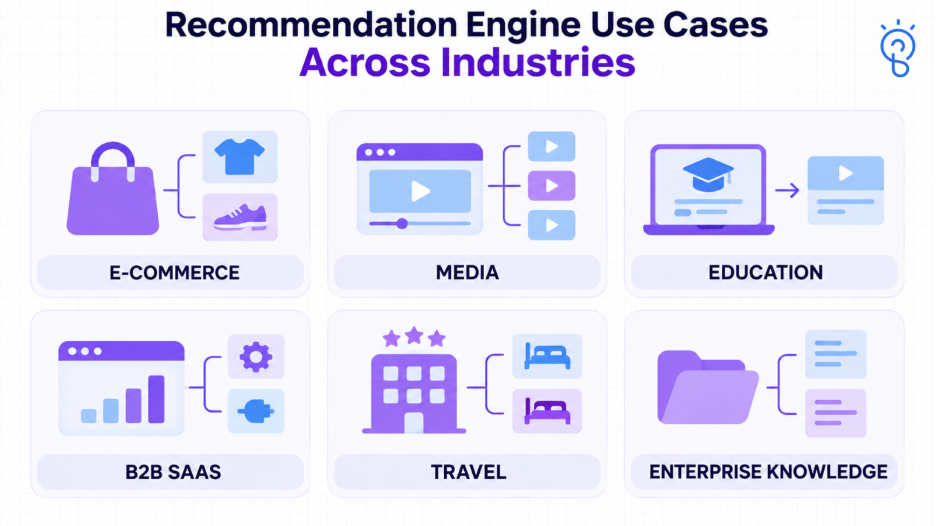
Recommendation engines help people find useful products, content, and information without searching through every available option.
Retail and E-commerce
Online stores recommend products based on what customers browse, buy, or show interest in. For example, someone buying a laptop might see a compatible charger or carrying case. Stores can also suggest similar products within the customer’s budget.
Benefit: Helps customers find suitable products and useful extras.
Read More: How Generative AI is Transforming Retail Personalization
Media and Publishing
Streaming services and publishing platforms suggest videos, music, podcasts, or articles based on what people enjoy. Recommendations can reflect what someone is viewing now while also introducing relevant content they have not tried.
Benefit: Makes finding interesting content easier and encourages people to return.
Education and Learning Platforms
Learning platforms suggest courses and lessons based on a person’s goals and progress. Someone who finishes a beginner course might receive a suitable next-level course or extra practice on a topic they found difficult.
Benefit: Helps learners choose what to study next.
B2B SaaS Products
Business software can suggest guides, templates, or features that help users complete their work. For example, a new user might see setup instructions, while someone connecting another application receives a relevant integration guide.
Benefit: Makes getting started easier and helps users get more value from the software.
Travel and Marketplaces
Travel sites and marketplaces recommend options that match a person’s budget, preferences, and needs. A hotel recommendation might consider travel dates, location, available rooms, and preferred facilities.
Benefit: Reduces browsing time and helps people find suitable options.
Enterprise Knowledge Platforms
Company knowledge platforms suggest internal documents and guides related to an employee’s work. For example, a support employee handling a customer issue might see a useful troubleshooting guide. Employees should only receive information they have permission to access.
Benefit: Helps employees find useful information faster.
What Are the Main Challenges of Recommendation Engines?
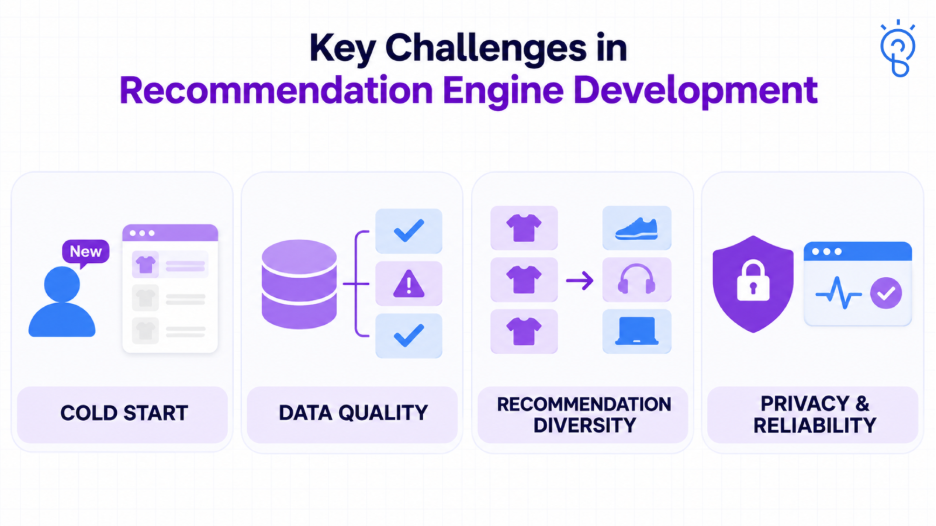
Recommendation quality depends on what the system knows, what it chooses to optimize, and how reliably it operates. The following challenges need explicit design decisions.
- Cold start: New users and items have little interaction history. Use preference questions, item details, popular options, or curated suggestions until more data becomes available.
- Filter bubbles and repetition: Repeatedly suggesting similar items can limit discovery. Include relevant new options, vary recommendations, and let users adjust their preferences.
- Incorrect data: Wrong user or product identifiers and bot activity can distort results. Check data quality before using it to generate recommendations.
- Outdated information: Old prices, stock levels, or availability can produce unusable suggestions. Keep important item details current.
- Inconsistent inputs: Differences between training data and live inputs can reduce recommendation quality. Keep feature definitions and data processing consistent.
- Exposure bias: Past activity reflects what users were shown, not everything they might enjoy. Test suitable unfamiliar items to learn beyond earlier recommendations.
- Access and privacy gaps: Suggestions can reveal restricted information through titles or previews. Enforce permissions and define what data is collected, retained, and deleted.
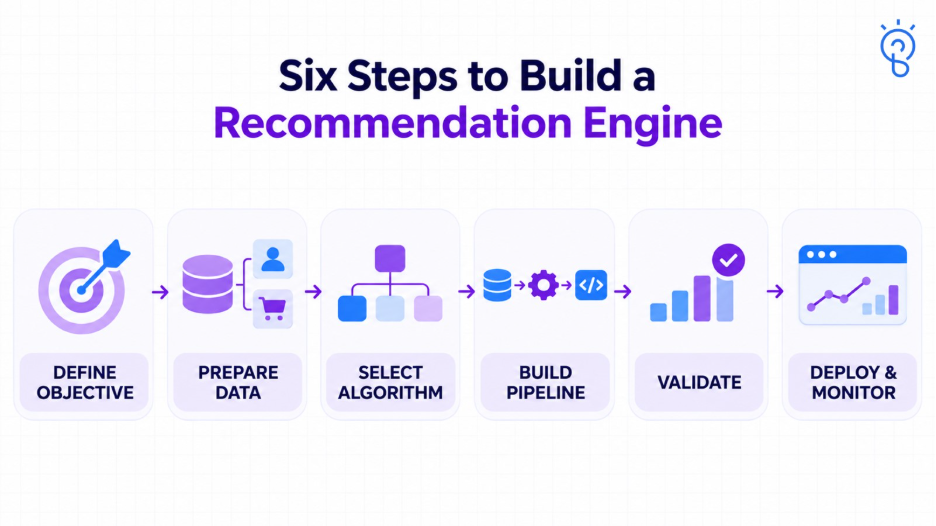
What Does It Take to Build a Recommendation Engine?
Build a recommendation engine around a measurable product decision, then add complexity only when evaluation supports it. The following sequence connects model development with production requirements.
1. Define the Placement and Objective
Specify where recommendations appear, who receives them, and what successful behavior means. A homepage discovery row and a checkout accessory list need different candidates, constraints, and success measures.
2. Audit and Instrument the Data
Check catalog completeness, identifiers, interaction timestamps, and available history. Capture impressions and outcomes with a consistent event schema. Determine which events represent meaningful preference signals for this use case.
3. Establish a Baseline and Select an Approach
Create a baseline such as contextual bestsellers, editorial selections, or attribute matching. Use content-based methods when item information is strong but behavior is sparse. Test collaborative filtering when interaction patterns are sufficiently informative. Combine methods when their strengths address different gaps.
There is no universal minimum interaction count. Catalog size, sparsity, repeat behavior, and the evaluation task all affect whether the data is useful.
4. Design Training and Serving
Specify data pipelines, model training, model versions, candidate storage or indexes, and the recommendation API. Add an online feature store or streaming infrastructure when freshness requirements justify them.
Define a latency budget and eligibility checks. Precomputed recommendations may suit a stable catalog; session-sensitive recommendations may need live features and request-time ranking.
5. Validate Before Expanding Exposure
Use a time-based evaluation design that approximates future recommendations. Ensure features and item availability reflect what was known at prediction time. Test new users, new items, invalid identifiers, stale data, empty results, and unavailable dependencies.
Check that fallback behavior and access restrictions work under failure, rather than testing only the successful model response.
6. Roll Out Gradually and Assign Ownership
Use a controlled experiment where feasible, expand exposure in stages, and retain a rollback path. Assign responsibility for data quality, model changes, incidents, and business outcomes.
How Do You Measure Recommendation Engine Performance and ROI?
Measure recommendation quality, production behavior, and incremental business value separately. A better offline ranking score does not establish a profitable improvement for real users.
Offline Quality and Production Metrics
Choose metrics that match the task. In the table below, K is the number of top-ranked items being evaluated, and relevance must be defined through an explicit labeling rule.
| Metric | What it tells you |
|---|---|
| Precision@K | The proportion of the top K recommendations labeled relevant |
| Recall@K | The proportion of known relevant test items recovered in the top K |
| NDCG@K | How well relevant items are ordered near the top, relative to the ideal order |
| Catalog coverage | The proportion of the eligible catalog recommended across a defined population and period |
| Diversity and novelty | How varied recommendations are and how much useful unfamiliar content they expose |
| Latency and error rate | How reliably recommendations arrive within the product’s response budget |
| Freshness and fallback rate | Whether inputs are current enough and how often the primary recommendation path is unavailable |
Report the evaluation population, time window, candidate pool, and averaging method. Historical relevance labels are incomplete, and changing negative sampling or candidate selection can change the score. Compare models under consistent conditions and include cold-start performance.
Business Outcomes and Incremental ROI
Use a randomized experiment where feasible to compare the new system with the current experience. Select a primary outcome such as completed purchases per eligible user, successful onboarding, or learning progression. Track guardrails such as returns, complaints, unsubscribes, and page latency.
Clicks on a recommendation widget do not prove additional demand: some users would have found and purchased the same item anyway. Measure incremental outcomes across the experience, with an appropriate observation period and an assessment of statistical uncertainty.
For a defined evaluation period, compare the recommendation initiative with the current experience:
ROI (%) = [(B − C) ÷ C] × 100, where C is greater than zero.
- B is incremental gross profit: The additional gross profit attributable to the improvement over the baseline experience, measured before deducting the initiative’s costs.
- C is the initiative’s total incremental cost: One-time development, data preparation, integration, and experimentation costs, plus additional infrastructure, service, and maintenance costs over the same evaluation period.
For a new implementation, include the costs required to introduce and operate it. For an upgrade, compare the proposed solution with the existing system and count the additional costs of making and operating the change. Exclude unrelated existing expenses, and do not count any cost twice if it has already been deducted when calculating B.
For internal productivity use cases, validate the value of time saved rather than assuming every saved minute becomes a cash saving.
How SapidBlue Can Help with Recommendation Engine Development?
Recommendation systems need coordinated work across machine learning, product integration, and data operations. SapidBlue’s recommendation engine development services cover product and content recommendations, collaborative and content-based methods, hybrid models, APIs, and performance optimization.
Relevant capabilities include:
- Recommendation engineering: Match the approach to the placement, available signals, and intended outcome.
- Data engineering: Connect catalog, customer, and interaction data through dependable data pipelines.
- Product integration: Deliver recommendations through application APIs and connect them with the surrounding user experience.
- Evaluation and optimization: Assess relevance, serving performance, and business outcomes as behavior changes.
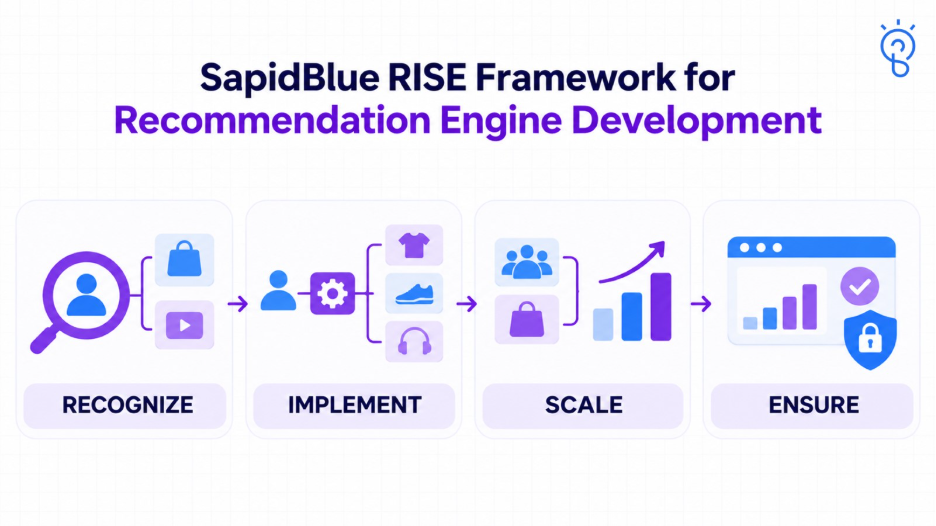
SapidBlue’s RISE approach gives each stage a distinct role:
| Stage | Application to recommendation development |
|---|---|
| Recognize | Identify the discovery problem, usable data, and personalization objective. |
| Implement | Build and integrate recommendation logic suited to the use case. |
| Scale | Expand capacity and coverage as users, items, and interaction volumes grow. |
| Ensure | Review quality, reliability, and access controls as the system evolves. |
The engagement should define acceptance criteria and ongoing responsibilities before rollout.
Also Read: Machine Learning & Advanced Analytics Services for Enterprises
Conclusion
A recommendation engine earns its place when it helps users make useful choices and produces measurable value for the business. The appropriate starting point may be a simple rules-based system, a content model, or a hybrid approach supported by behavioral data.
Choose the initial scope around a real discovery problem, then use evidence to decide what deserves further investment.
Plan a recommendation-engine implementation with SapidBlue around your data, product requirements, and measurable business goals.