
 Contact Us

 Key Takeaways

To build an app like Uber, start with a rider app, a driver app, and an operations dashboard connected to a backend that quotes fares, matches drivers, tracks trips, and handles payments. Launch a minimum viable product (MVP) in one service area with one ride category and a verified driver pool. Use that pilot to find out whether you can fulfill rides reliably and earn enough per trip to support expansion.
Consider an airport transfer service. The booking screen can work perfectly while riders still miss pickups because drivers wait in the wrong terminal or dispatch loses contact with a driver. Your first release needs to handle those failures as carefully as it handles a successful trip. This guide covers the features, architecture, build process, and budget needed to do that.
What Does It Take to Build an App Like Uber?
An Uber-like app runs a ride-hailing service: a passenger requests transport; the platform assigns an available driver, and the operator handles payment and exceptions. It can serve an existing fleet or a marketplace that brings together independent drivers and riders. The marketplace adds a separate job: attracting and retaining enough drivers and riders in the same places and at the same times.
What is a Ride-Hailing App?
A ride-hailing app lets passengers request a ride from an available driver. Riders enter their pickup location and destination, review a fare estimate, and track the driver’s arrival. Drivers receive trip requests through a separate app, while the platform manages matching, trip updates, and payments.
Why Build a Ride-Hailing App?
Three business reasons can justify the investment:
- Meet a specific transport need. A local operator might serve airport pickups, accessible transport, or employer shuttles with service rules that general ride-hailing apps don’t support.
- Reduce manual coordination. Digital booking and dispatch can replace repeated phone calls and give staff a shared view of who is available, which rides are late, and what needs intervention.
- Build a direct booking channel. Fleet operators can manage customer accounts and repeat bookings themselves, with control over service coverage, pricing rules, and customer support.
The same model can support roadside assistance, local parcel delivery, and home services. Each adapts the matching rules: a tow truck needs the right equipment, a courier may need proof of delivery, and a technician needs the right skills and time slot.
What Are the Core Features of an Uber-Like App?
The first release needs to support a complete ride across three interfaces. Include the operations dashboard early so your team can act when a driver cancels, a pickup goes wrong, or a payment fails.
| Interface | Core MVP features | Add when demand warrants it |
|---|---|---|
| Rider app | Sign-in, pickup and destination selection, fare estimate, booking and cancellation, driver and vehicle details, live trip status, payment, receipt, and support access | Scheduled rides, multiple stops, saved preferences, and corporate accounts |
| Driver app | Onboarding and verification, online status, ride offers, accept or decline, directions, arrival and trip controls, location sharing, earnings history, and incident reporting | In-app navigation, demand forecasts, and advanced earnings tools |
| Operations dashboard | Driver approval, service zones and fare rules, active trip view, manual dispatch, cancellation and refund handling, access controls, and audit history | Fleet reporting, automated dispute triage, and city-level dashboards |
Pick the smallest viable payment flow for the service model. A fleet that already runs payroll may only need rider payment and revenue reconciliation. A marketplace that pays third-party drivers needs a plan for driver onboarding, earnings records, and payouts in addition to rider checkout.
How Does an Uber-Like App Work?
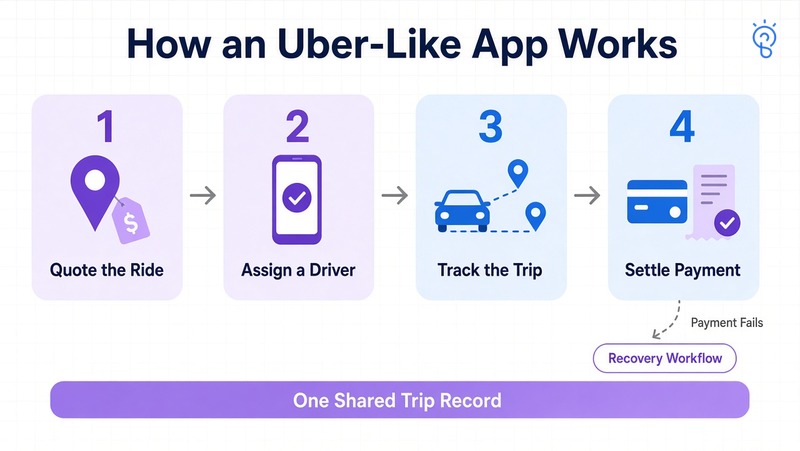
The ride-hailing backend coordinates booking, assignment, trip progress, and payment. Both apps read the same trip record, so a late notification or interrupted connection cannot independently move a trip to a different status.
- Quote the ride. The rider enters a pickup and destination. The backend checks service coverage and calculates an estimate using route data and the applicable fare rules. Store the quote and its expiry so support can see what the rider was offered.
- Request and assign a driver. The backend finds eligible drivers, sends offers, and confirms one valid acceptance. If nobody accepts, the rider receives a clear update and dispatch can intervene where appropriate.
- Track pickup and travel. The driver reports arrival, starts the ride, and completes it. The rider sees current status and location updates, and the operator can inspect the trip if something goes wrong.
- Settle payment. The backend calculates the final fare, records the payment outcome, and issues a receipt. Where the platform pays drivers, it separately records earnings and reconciles payouts.
A completed ride and settled payment are different records. If a payment fails after drop-off, keep the trip completed and send the payment issue to a recovery workflow.
What Backend Architecture Does an Uber-Like App Need?
A ride-hailing backend needs a reliable record of trips and payments, a fast path for location updates and matching, and background processing for work that can wait. For a single-market MVP, one backend with separate booking, dispatch, payment, and admin modules is a practical starting point. Split out a workload when traffic or operational needs justify running it separately.
| Backend component | Design for a first launch |
|---|---|
| Booking and trip management | Store trip state and allowed transitions in a transactional database. Use a version check or a row lock in an assignment transaction so two drivers cannot win the same trip. Also enforce one active assignment per driver if the pilot permits only one trip at a time. |
| Location and dispatch | Maintain each available driver’s latest position, timestamp, and availability in a searchable location index. Filter stale positions and enforce eligibility before sending an offer. Recheck eligibility before confirming acceptance. |
| Payments and reconciliation | Keep internal records of charges, refunds, driver earnings, and payouts as applicable. Use an idempotency key so retrying the same charge does not create a second one. Verify and deduplicate provider webhooks, then reconcile records with provider settlements. |
| Live updates and background jobs | Use a live connection for in-app updates and push notifications for alerts. Queue receipts, notifications, and other retryable work after the business record is saved. On reconnect, fetch the current trip before applying live updates. |
| Operations and access control | Scope trip and location access by role and assignment. Log privileged actions such as fare overrides, reassignments, and refunds, including who acted and why. |
Keep frequent GPS writes separate from updates to the authoritative trip record. As an illustration, 1,000 online drivers reporting once every five seconds produce about 200 location updates per second before retries or bursts. That helps size the location path even if booking traffic is much lower. Choose the actual update cadence based on device battery use, connectivity, and how fresh a position needs to be.
How Do Real-Time Driver Matching and GPS Tracking Work?
Driver matching starts by filtering nearby drivers by availability, service area, ride category, and location freshness. Rank the shortlist by estimated pickup time over the road network. A car across a river may be closest on the map and still take longer to reach the rider.
Set an expiry for each offer and confirm an acceptance on the server. If an offer expires or a driver declines, move to another candidate or widen the search within the service zone. Test what happens if a rider cancels at the same moment a driver accepts.
The driver app sends timestamped location updates while tracking is needed. On the rider map, show when the last reliable update arrived and flag stale positions. Test background tracking with real devices, including screen lock, weak signal, battery-saving settings, and denied permissions. Android’s background location guidance explains how permission and accuracy choices can affect the driver app.
What Technology Stack Should You Use?
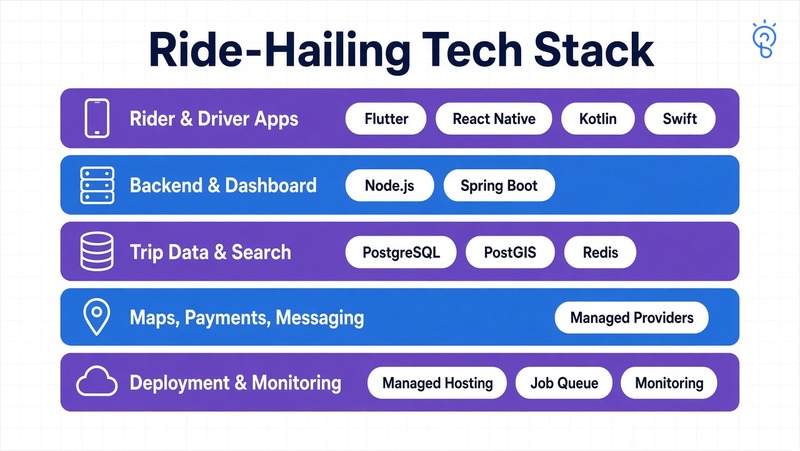
Choose a stack your team can run and debug while rides are in progress. A shared mobile codebase can simplify delivery, but the driver app still needs device-specific testing for location and notifications.
- Rider and driver apps: Flutter or React Native for shared development across iOS and Android. Consider Kotlin or Swift where the driver experience depends on deeper control of device features.
- Backend and dashboard: A stack the team already supports, such as TypeScript with Node.js or Java with Spring Boot, plus a web dashboard for dispatch and support.
- Trip data and driver search: PostgreSQL for durable records and PostGIS for geographic queries. Add a fast location store such as Redis if location write volume and lookup latency justify it.
- Maps, payments, and messaging: Use managed providers where they fit. Verify pickup and routing quality in the launch area, payment and payout coverage, and what you can do if a provider is unavailable.
- Deployment and monitoring: Start with managed hosting, database backups, a job queue, and monitoring that follows a trip across booking, dispatch, and payment.
How to Build an App Like Uber: Step by Step
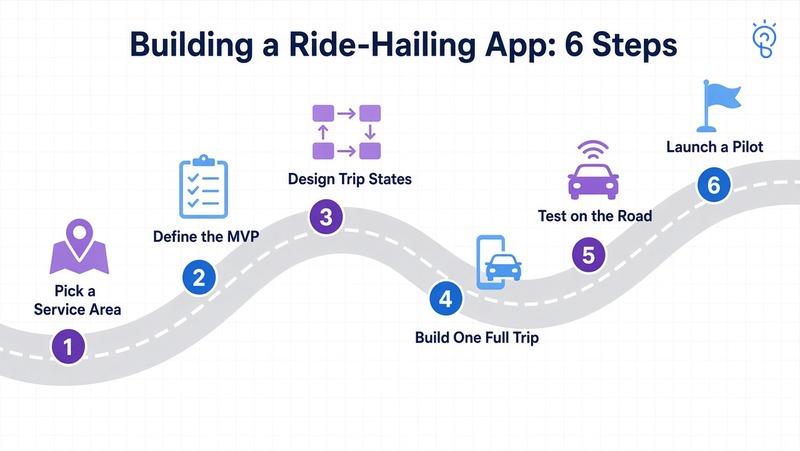
Build one serviceable booking-to-payment flow, then use a field pilot to decide what deserves more investment. A feature can wait if the operator can handle the occasional exception manually and the pilot still produces reliable evidence.
- Choose the first service area and driver model. Define who you serve, when rides are available, and who supplies the vehicles. Test demand with real bookings or a dispatch trial. Confirm which local transport, insurance, and driver onboarding requirements apply before committing to a launch date.
- Define the MVP and its operating rules. Pick one ride category, one payment flow, and the first supported devices. Agree on service boundaries, fare rules, cancellation handling, and who is responsible for rider and driver support. Defer pooling, loyalty, and multi-city features.
- Design the trip states and exceptions. Prototype rider booking and driver acceptance together. Write down what happens if no driver is available, a pickup point changes, or a charge fails. Decide which operations staff can perform and what they must record.
- Build one complete trip first. Connect the rider app, driver app, and dashboard to the backend. Run a test ride through dispatch, pickup, completion, payment, and reconciliation before adding secondary screens. This exposes integration problems while the scope is still small.
- Test on the road and rehearse failures. Try ambiguous pickup points, weak GPS, lost connectivity, simultaneous driver acceptance, delayed payment notifications, and provider outages. Verify that an operator can see the issue and help the rider or driver recover.
- Launch a controlled pilot and review the results. Start with a known driver pool and defined operating hours. Measure request-to-assignment time, completion rate, cancellations, and support cases by zone and time. Set expansion criteria using the service promise you made to riders.
How Much Does It Cost to Build an App Like Uber in 2026?
In an illustrative 2026 budget, a custom single-zone ride-hailing MVP costs about $110,000–$166,000 USD to develop. The estimate assumes 1,600–2,400 delivery hours at an assumed blended rate of $60 per hour, plus a 15% contingency. It covers two cross-platform mobile apps, a basic dispatch dashboard, and integrations with managed maps and payments.
This example is a planning scenario, not a market average or a SapidBlue quote.
| Workstream | Assumed hours | Labor at $60/hour |
|---|---|---|
| Discovery, trip design, and prototypes | 160–240 | $9,600–$14,400 |
| Rider and driver mobile apps | 480–720 | $28,800–$43,200 |
| Backend, integrations, and operations dashboard | 560–800 | $33,600–$48,000 |
| Quality assurance and field testing | 280–440 | $16,800–$26,400 |
| Deployment, monitoring setup, and handover | 120–200 | $7,200–$12,000 |
| Labor subtotal | 1,600–2,400 | $96,000–$144,000 |
| Budget with 15% contingency | $110,400–$165,600 |
The scope assumes one market, one currency, one ride category, and basic fares and dispatch. Features such as automated marketplace payouts, scheduled trips, multiple vehicle categories, and integrations with existing fleet systems need their own estimates. A fleet pilot may be simpler if existing tools already handle driver onboarding, payroll, or dispatch.
What Does It Cost to Run a Ride-Hailing App?
Budget separately for hosting, maps and routing, messaging, payment processing, maintenance, and support. The development estimate also excludes driver recruitment, marketing, insurance, licensing, and launch incentives. Those costs belong in the business plan even though they do not appear on the software quote.
Model usage based on requests and dispatch attempts, including trips that never get booked or completed. Checking eight drivers against one pickup produces eight elements in one matrix call. Filtering candidates before routing can reduce both lookup work and the number of billable elements.
How Long Does It Take to Build an Uber-Like App?
The example MVP would take about 14–20 weeks of delivery time at a team capacity of 120 project hours per week. That is an estimate based on the same 1,600–2,400 hours, rounded to whole weeks. Provider onboarding, app review, fleet readiness, and local approvals can extend the date when riders can book. Run those workstreams alongside development where possible.
Should You Build Custom Software or Use a White-Label App?
A white-label ride-hailing app can shorten setup if its dispatch, pricing, and payment workflows already fit your business. Test the vendor’s demo against a failed payment, a driver reassignment, and a refund before signing. Ask how you can export trip and payment data and transfer app store accounts or provider credentials if you leave.
Custom development makes more sense when your competitive advantage depends on how you allocate rides, integrate with fleet or enterprise software, or handle service requirements the vendor cannot support. Compare the options over the same period, including subscriptions, custom changes, support, and the cost of switching later.
What Are the Biggest Challenges in Building an Uber-Like App?
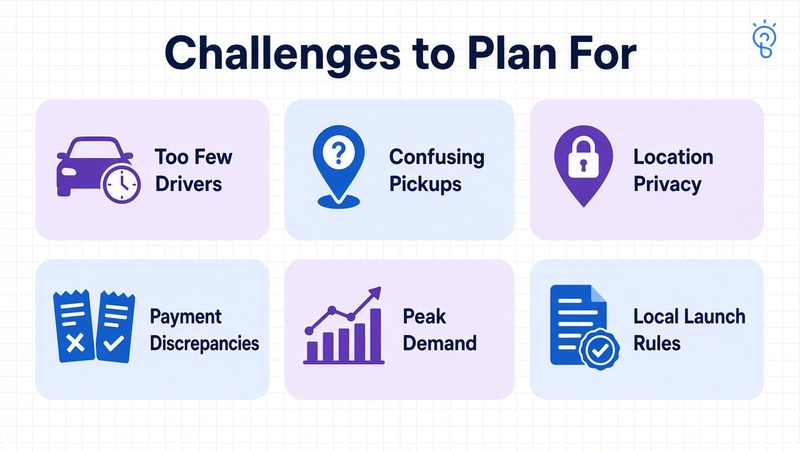
Ride-hailing failures have immediate consequences: someone may be left waiting, a driver may lose a booking, or a rider may be charged incorrectly. Plan for problems across the software and the local service.
- Too few drivers at the right time: Concentrate supply in the first zone and during defined hours. Monitor unfulfilled requests by location and time instead of relying on citywide signup totals.
- Confusing pickup points: Let riders confirm or adjust the pickup pin and share a landmark. Test airports, large venues, and streets where the correct side of the road matters.
- Location privacy and rider safety: Limit precise location access to those who need it, restrict when tracking runs, and set retention rules for trip histories. Give staff a clear process and owner for handling safety incidents.
- Payment and payout discrepancies: Reconcile the platform’s transaction records against provider reports and investigate unresolved differences. Show support staff the difference between an authorized charge, a captured charge, and a refund.
- Service disruption during peak demand: Test bursts of bookings, GPS traffic, and slow provider responses together. Define when dispatch should fall back to manual handling or pause new bookings while existing trips continue.
- Local launch requirements: Assign an owner to confirm operating permissions, insurance, onboarding checks, and reporting obligations for each market before opening it.
How Do You Monetize and Scale a Ride-Hailing App?
- Choose a revenue model that fits your business: A marketplace can earn a commission or charge a booking fee. A fleet operator can collect fares directly, offer corporate transport contracts, or license its dispatch software to other fleets.
- Offer subscriptions where usage supports them: A ride pass can work for frequent riders, while a monthly dispatch plan can suit fleet operators. Check whether the expected usage and service costs support the price.
- Calculate contribution per completed ride: For example, a $20 fare minus $15 in driver earnings and $2 in variable costs leaves $3 per ride before fixed costs and taxes. Variable costs can include payment processing, maps, messaging, support, and incentives.
- Account for rides that don’t go as planned: Include applicable costs from failed or canceled requests, and account for refunds consistently, so they aren’t missed or counted twice.
- Expand zone by zone: Check driver coverage, the share of requests fulfilled, pickup reliability, and contribution per ride by area and shift. Citywide averages can hide weak demand or driver shortages in the next zone you plan to open.
Where Can AI Improve Ride-Hailing Apps?
AI is most useful when it solves a measured problem that rules and routing alone leave unresolved. For example, Uber Engineering’s DeepETA write-up describes using machine learning to correct route-based arrival estimates using observed trips. A new service can start with a routing provider and measure pickup ETA errors before investing in a model of its own.
Other opportunities include forecasting demand by zone and time, flagging suspicious patterns for review, and sorting support cases. Measure each use case against a baseline, such as pickup ETA error or the time staff spend reviewing flagged rides.
Which Ride-Hailing Trends Are Worth Planning For?
Three directions can affect the architecture of a ride-hailing app as it grows:
- Dispatch across partner fleets: A platform that can assign trips to multiple operators needs shared availability data and clear responsibility for cancellations, support, and settlements.
- Electric fleet dispatch: If your fleet uses electric vehicles, matching may need to account for battery range and charging downtime as well as pickup ETA.
- Autonomous vehicle integrations: If a future service will use an autonomous fleet, plan for a different trip handoff, pickup instructions, and a way to reach support without relying on a driver.
How Do You Choose a Ride-Hailing App Development Partner?
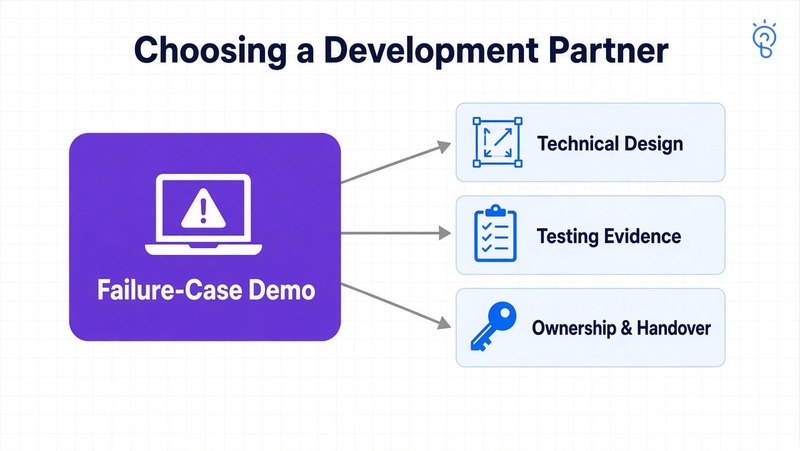
Ask a prospective partner to demonstrate a ride under failure conditions. A useful demo shows what a dispatcher sees when the driver’s connection drops, two drivers try to accept the same ride, or a payment notification arrives late.
- Technical design: Ask who owns trip state, how driver assignment is confirmed, and what happens if maps or payments are unavailable.
- Testing evidence: Ask for a plan covering background GPS, low connectivity, duplicate requests, payment reconciliation, and realistic peak traffic.
- Ownership and handover: Confirm access to the source code, deployment accounts, app listings, and operational data. Define who handles incidents, updates dependencies, and supports the pilot after launch.
How SapidBlue Can Help with Ride-Hailing App Development?
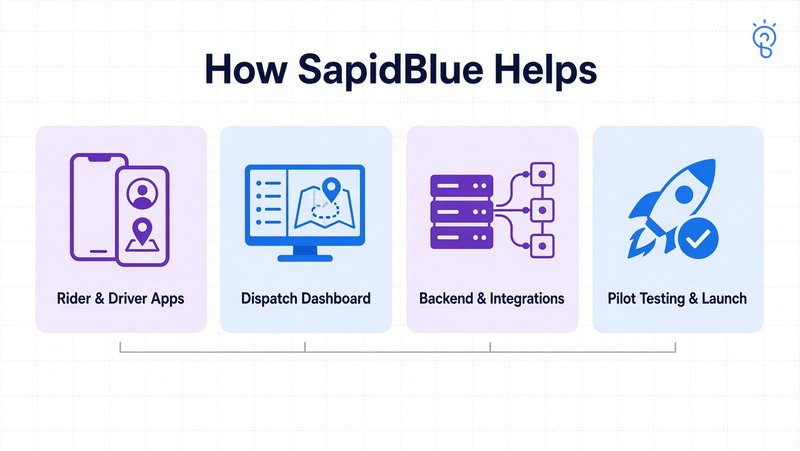
SapidBlue provides mobile and web app development and cloud engineering for products with connected workflows. For a ride-hailing project, that can include rider and driver apps, a dispatch dashboard, and the backend that connects booking, location, and payment services.
- Rider and driver apps: Build fare estimates, ride booking, driver acceptance, live trip tracking, and receipts for iOS and Android.
- Dispatch dashboard: Give operators one place to monitor active rides, reassign drivers, and handle cancellations or payment issues.
- Backend and integrations: Connect booking, GPS, maps, payments, and notifications with existing fleet software. Keep trip status consistent across both apps and the dashboard.
- Pilot testing and launch: Test weak GPS signals, missed ride offers, and failed payments so your team knows how to respond before opening the service to more riders.
Conclusion
If you want to build an app like Uber, first decide what a dependable ride looks like in your launch area. The pilot should show whether drivers can meet that promise, whether operators can recover when a trip goes wrong, and whether the numbers support opening another zone.